纹
Character Story & Explanation
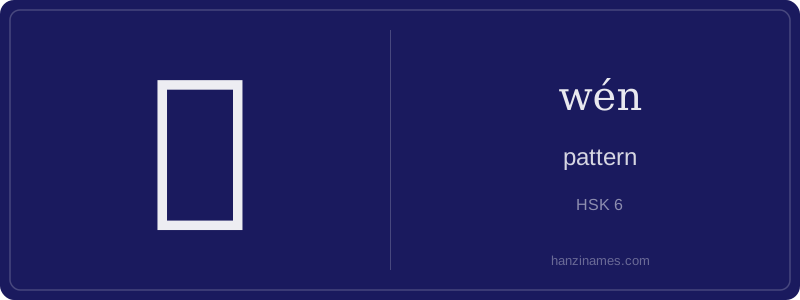
In daily life, 纹 is indispensable across fields: textile labels list ‘提花纹’ (tīhuā wén, jacquard pattern), medical reports note ‘皮肤纹’ (pífū wén, skin lines), and smartphone specs cite ‘屏纹’ (píng wén, screen grain). Historically, the Tang-dynasty *Tang Liudian* documents imperial silk workshops classifying ‘云纹’ (yún wén, cloud pattern) and ‘雷纹’ (léi wén, thunder pattern) as regulated decorative motifs on official robes — proof of its bureaucratic and artistic weight.
The character’s earliest attested form appears in seal script (c. 3rd century BCE), where 纟 + 文 already coalesced. It is not a pictograph but a logical compound: no oracle-bone or bronze inscriptions show a standalone ‘纹’ — it emerged later as writing matured and needed precise terms for surface aesthetics. Today, Chinese people instantly recognize it in phrases like ‘指纹’ (zhǐwén, fingerprint) — over 1.4 billion ID cards and smartphones use this term daily.
Our detective begins at the crime scene: the character 纹. First, observe its radical — 纟 (sī), the ‘silk’ radical — a telltale sign it’s tied to textiles and fine surface features. This isn’t coincidence: in ancient China, silk weavers meticulously documented thread patterns, and ‘纹’ emerged as the lexical fingerprint for any deliberate or natural linear trace — from brocade motifs to wood grain. Its seven-stroke form is compact but precise: three silk strokes on the left, then ‘文’ (wén, ‘culture’, ‘inscription’) on the right, suggesting pattern as cultural expression.
Zooming in, ‘文’ itself was originally a pictograph of a standing human with intersecting chest markings — likely ritual tattoos or ceremonial designs. When fused with 纟, 纹 evolved beyond mere decoration into a semantic umbrella: any discernible line or repetition that carries meaning — be it a scar, a fingerprint, or a marble countertop’s swirl. Linguistically, it’s a phono-semantic compound: 纟 signals domain (fabric/surface), while 文 provides both sound (wén) and conceptual weight (inscribed order).
By the Han dynasty, 纹 appears in technical texts like the *Kaogongji* (Record of Trades), describing lacquerware grain and bronze mold textures. It never meant ‘random scratch’ — always intentional or inherent structure. Even today, calling something ‘有纹’ (yǒu wén) implies aesthetic or diagnostic value: a geologist reads rock纹; a dermatologist maps skin纹; a designer selects fabric纹. The character thus embodies a uniquely Chinese epistemology: meaning resides not just in objects, but in their visible, repeatable traces.
Example Sentences
Common Compounds
Similar Characters — Don't Mix These Up
Your First Step into Chinese Culture: Get a Chinese Name
Every journey into Chinese begins with a name. Use our free Chinese name generator to create a meaningful, personalized Chinese name that fits you perfectly.
Get My Chinese Name →