纽
Character Story & Explanation
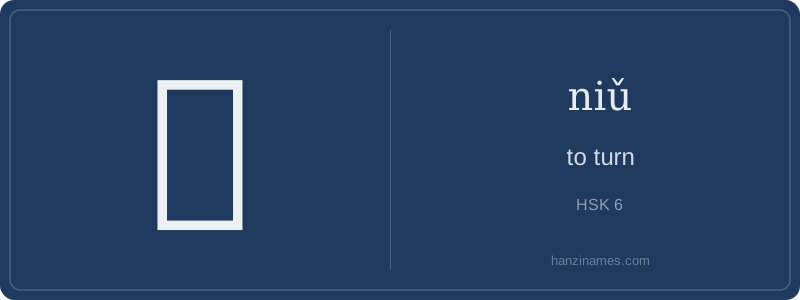
In modern Chinese, 纽 is most commonly used in formal, technical, or literary contexts—not in daily speech like ‘eat’ or ‘go’. It appears in compound words such as 纽带 (niǔdài, ‘bond’ or ‘tie’), 纽结 (niǔjié, ‘knot’ or ‘junction’), and in political discourse like 中美关系的新纽带 (‘a new bond in China–US relations’). It also survives in historical terms: the ‘Imperial Seal of the Yuan Dynasty’ was secured by a ‘dragon-button knob’ called 钮 (a variant form sharing the same root), illustrating its enduring association with pivotal, fastening points.
The character’s written form derives from the ancient seal script form of 丑 (chǒu), which originally depicted a hand gripping and twisting something—a gesture preserved in the modern shape. While not a direct pictograph, its structure reflects Bronze Age metallurgical and textile terminology where ‘turning’ meant functional binding, confirmed by inscriptions on Warring States bronze vessels and Han bamboo manuscripts.
As an archaeologist brushing dust from a Han dynasty bamboo slip, I uncovered 纽—not as a static glyph, but as a dynamic verb fossilized in ink: ‘to turn’, ‘to twist’, ‘to connect’. Its silk-thread radical (纟) whispers of ancient textile craft—where turning threads formed knots, loops, and bindings. This wasn’t mere motion; it was *intentional torsion*: twisting rope to secure a cart axle, winding silk to fasten a ritual garment. The character preserves the tactile intelligence of early Chinese artisans who understood ‘turning’ as both physical action and structural principle.
The seven strokes tell a micro-history: two short diagonal hooks (the ‘silk’ radical’s signature) anchor the left, while the right side—丑—originally depicted a *twisted hand* in seal script, later stylized into its modern form. In excavated Western Han texts, 纽 appears in administrative records describing ‘twisting bronze cords’ for official seals and ‘turning the pivot’ of irrigation sluices—evidence that niǔ encoded precision mechanics long before abstract usage.
Unlike pictographs frozen in time, 纽 evolved *functionally*: its core meaning ‘to turn’ expanded metaphorically to ‘to link’ or ‘to hinge upon’, because turning creates connection—like twisting two strands into one cord. This semantic pivot mirrors how early Chinese cosmology linked motion and relationship: the turning of celestial bodies governed human ties. So when we read 纽 today, we’re not just seeing a word—we’re holding a torque wrench calibrated by 2,000 years of embodied knowledge.
Example Sentences
Common Compounds
Similar Characters — Don't Mix These Up
Your First Step into Chinese Culture: Get a Chinese Name
Every journey into Chinese begins with a name. Use our free Chinese name generator to create a meaningful, personalized Chinese name that fits you perfectly.
Get My Chinese Name →