纺
Character Story & Explanation
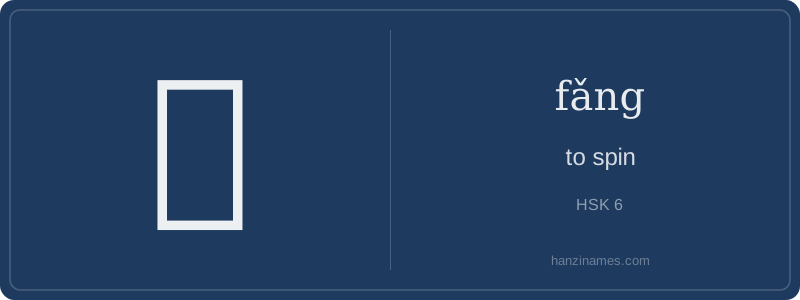
In contemporary China, 纺 appears daily in factory signage (‘纺纱车间’ – spinning workshop), government policy documents on textile modernization, and product labels for certified organic cotton garments. It’s central to the phrase 纺织工业 (fǎngzhī gōngyè, 'textile industry'), a term enshrined in China’s Five-Year Plans since 1953. The idiom ‘纺车不停,家业不倾’ (a spinning wheel never stops; thus, the family business endures) reflects its historical association with diligence and household stability—documented in Ming-dynasty agricultural manuals like Complete Book of Agriculture (1639).
The character evolved from seal script around the Qin dynasty. Its left side 纟 is a standardized form of 糸 (mì), meaning ‘silken thread’, and clearly depicts intertwined filaments. The right side 方 was adopted phonetically—not pictorially—and has no visual connection to spinning. No oracle-bone or bronze inscriptions of 纺 survive; earliest verified forms appear in Han-era bamboo slips referring to state-run spinning quotas.
The character 纺 (fǎng) captures the ancient, rhythmic motion of spinning raw fibers—like cotton or silk—into thread by hand or machine. Its left-side radical 纟 (sī), meaning 'silk' or 'thread', immediately signals its textile domain, while the right component 方 (fāng) serves as a phonetic hint, approximating the pronunciation. This character embodies both craft and industry: from rural women spinning flax in Jiangsu villages centuries ago to modern textile factories in Shaoxing supplying global fashion brands.
Historically, spinning was foundational to China’s economy and gender roles—women’s ‘spindle and loom’ labor was celebrated in poetry and state records as early as the Han dynasty. 纺 appears in official terminology like 纺织 (fǎngzhī, 'spinning and weaving'), a pillar sector that employed over 18 million people in China as of 2022 (China National Bureau of Statistics). The character rarely stands alone in speech but thrives in compound words denoting process, machinery, or material origin.
Though HSK Level 6, 纺 is highly contextual and rarely used colloquially outside technical or industrial settings. Learners encounter it most often in news about manufacturing, sustainability reports (e.g., eco-friendly 纺织品), or cultural heritage programs reviving traditional spinning techniques. Its simplicity (7 strokes) belies its deep socioeconomic resonance—each stroke traces a lineage from hand-spun hemp cord to high-performance synthetic yarn.
Example Sentences
Common Compounds
Similar Characters — Don't Mix These Up
Your First Step into Chinese Culture: Get a Chinese Name
Every journey into Chinese begins with a name. Use our free Chinese name generator to create a meaningful, personalized Chinese name that fits you perfectly.
Get My Chinese Name →