绑
Character Story & Explanation
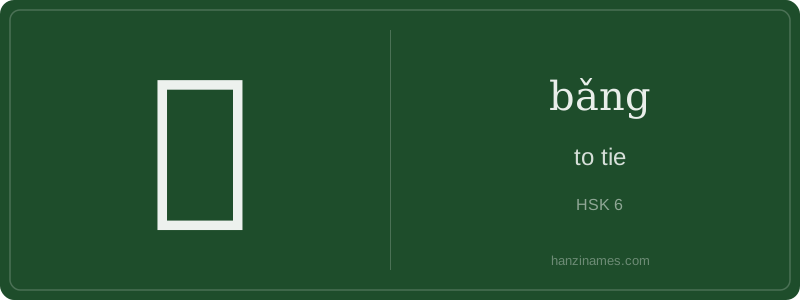
绑 is widely used in contemporary Chinese for practical binding tasks (e.g., packaging, construction) and formal contexts like law enforcement ('绑匪' — kidnapper; '捆绑销售' — bundled sales). A documented idiom is 捆绑销售 (kǔn bǎng xiāo shòu), regulated by China’s Anti-Monopoly Law since 2008, referring to coercive product bundling. The character also appears in official documents, news reports on crime, and e-commerce logistics (e.g., '快递需绑带加固').
The character evolved from seal script (c. 3rd c. BCE), where the left side 纟 clearly represented silk threads, and the right side 邦 (bāng) served as a phonetic component—no pictographic origin. Modern standard form (9 strokes) was codified in the 1956 and 1964 PRC character reforms; no oracle bone or bronze inscription forms of 绑 exist—the character postdates those periods.
The Chinese character 绑 (bǎng) means 'to tie' or 'to bind'—a physical action with strong semantic and metaphorical weight. Unlike English verbs like 'tie' or 'bind', which often imply temporary, neutral, or even positive associations (e.g., 'tie a bow', 'bind a book'), 绑 frequently carries connotations of constraint, coercion, or urgency—especially in modern usage. It appears in contexts ranging from securing packages to restraining suspects, reflecting its functional gravity in daily communication.
In Chinese grammar, 绑 is a transitive verb requiring an object (e.g., 绑绳子, 绑人), and it rarely stands alone without context. Its radical 纟 (silk/thread) signals association with textiles and binding materials—a consistent visual cue across characters related to string, rope, and connection. This contrasts with Western alphabetic scripts, where no such visual morphological system exists to signal semantic categories.
Culturally, 绑 evokes imagery tied to discipline, security, and social control—echoing historical practices like binding feet (though that used 缠, not 绑) or modern law enforcement protocols. In contrast, Western equivalents like 'tie up' or 'restrain' are more context-dependent in tone: 'tie up loose ends' is idiomatic and positive, while 'tie someone up' is literal and potentially negative. 绑 lacks such widespread positive idioms—it remains grounded in concrete, often urgent, physical action.
Example Sentences
Common Compounds
Similar Characters — Don't Mix These Up
Your First Step into Chinese Culture: Get a Chinese Name
Every journey into Chinese begins with a name. Use our free Chinese name generator to create a meaningful, personalized Chinese name that fits you perfectly.
Get My Chinese Name →