缀
Character Story & Explanation
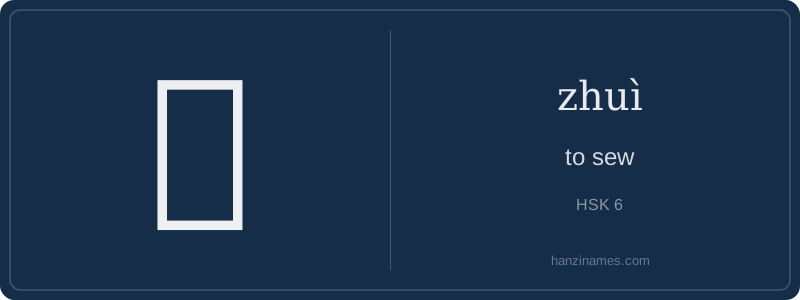
缀 is commonly used in modern Mandarin in compound verbs like 缀合 (zhuìhé, 'to join/assemble') and 缀饰 (zhuìshì, 'to embellish'), especially in academic, literary, or technical contexts—for example, linguists use 缀词 (zhuì cí) to describe affixation in morphology. A well-documented idiom is 断断续续 (duàn duàn xù xù, 'intermittent'), where 续 (xù) shares the same root meaning 'to continue'—though not identical, it reflects the semantic field of connection that 缀 belongs to.
The character 缀 first appeared in seal script during the Warring States period (475–221 BCE). Its structure combines 纟 (silk/thread) on the left and 辍 (chuò, 'to stop') on the right—but historically, the right component evolved from 惙 (a variant meaning 'to attach'). So rather than 'stopping thread', it originally conveyed 'threading on'—a documented shift confirmed by Shuōwén Jiězì (100 CE), which defines 缀 as 'joining with thread'. No oracle bone form survives; its earliest attested forms are in bronze inscriptions emphasizing attachment, not interruption.
The character 缀 (zhuì) embodies the Chinese worldview that meaning arises through careful, intentional connection—not isolated elements, but relationships stitched together. Historically tied to textile craft, it reflects a cultural reverence for continuity: mending tears, joining fragments, or embellishing plain cloth with embroidery all signify restoring harmony and adding value through deliberate linkage. This mirrors broader Confucian and Daoist ideals—where virtue is cultivated through relational practice, not solitary perfection.
In classical literature and administrative language, 缀 appears in contexts like 缀文 (zhuì wén)—'to compose prose'—revealing how writing itself was seen as weaving thoughts into coherent patterns. The act of 'sewing' extends metaphorically to language, ethics, and governance: just as loose threads weaken fabric, fragmented words or broken promises undermine social trust. Thus, 缀 subtly encodes the belief that integrity resides in how things are joined.
Even today, when Chinese speakers say 缀饰 (zhuìshì, 'to ornament') or 缀合 (zhuìhé, 'to join together'), they invoke an aesthetic and moral sensibility where beauty and truth emerge from thoughtful integration—not dominance or erasure. The radical 纟 (sī), meaning 'silk thread', grounds this concept in material culture: silk, once China’s diplomatic currency and spiritual symbol, represents refinement achieved only through meticulous, patient labor. To 缀 is to participate in civilization’s quiet, essential work—the stitching of meaning across time and people.
Example Sentences
Common Compounds
Similar Characters — Don't Mix These Up
Your First Step into Chinese Culture: Get a Chinese Name
Every journey into Chinese begins with a name. Use our free Chinese name generator to create a meaningful, personalized Chinese name that fits you perfectly.
Get My Chinese Name →