缘
Character Story & Explanation
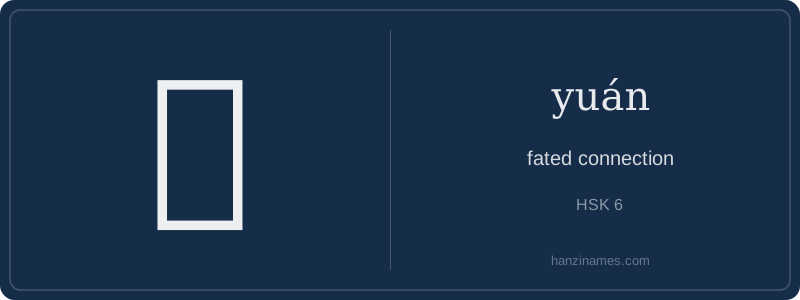
缘 is widely used in modern Chinese to express serendipitous human connections—especially in relationships, reunions, and chance meetings. It appears in official media, literature, and daily speech: CCTV news might report on ‘cross-strait kinship’ using 血缘 (xuè yuán, 'blood ties'), while social media posts celebrate friendships with 有缘千里来相会 ('Fated friends meet across a thousand miles'). The idiom 三生有幸 (sān shēng yǒu xìng, 'Three lifetimes of fortune') often pairs with 缘 to express profound gratitude for meeting someone special.
The character evolved from seal script (c. 3rd century BCE), where its left side already showed the silk radical (纟), reflecting its association with binding ties. The right component originally resembled 袁 (yuán), a phonetic element indicating pronunciation—not a pictograph. No oracle bone form survives, and scholars confirm its earliest attested use is in Warring States bamboo texts (475–221 BCE) referring to 'conditions' or 'circumstances'—later deepening into 'karmic cause' under Buddhist influence.
Hi students! Today we’re learning 缘 (yuán), a beautiful and deeply cultural character. Though its basic dictionary meaning is 'cause' or 'reason', in real Chinese usage it almost always points to an invisible, meaningful connection—especially between people. Think of it as 'fated affinity' or 'karmic bond'. It’s not about logic or causality like in science, but about emotional resonance and serendipity. This subtle nuance makes 缘 one of the most poetic words in Chinese—and why it appears everywhere from love songs to Buddhist texts.
Notice its radical: 纟 (sī), the 'silk' or 'thread' radical. That’s no accident! In ancient China, silk threads symbolized delicate, unbreakable ties—just like human relationships. The right side, 辶 (chuò), is the 'walking' or 'movement' radical, suggesting that such connections unfold over time and space. So visually, 缘 paints a picture of threads weaving through life’s journey—quietly linking people across distance and time.
At HSK Level 6, 缘 signals advanced fluency—not because it’s hard to read, but because mastering it means understanding layers of Chinese worldview. It carries Confucian warmth, Daoist spontaneity, and Buddhist karma. You’ll rarely hear it alone; it thrives in compounds like 有缘 (yǒu yuán, 'we’re destined to meet') or 无缘 (wú yuán, 'no karmic link'). When a Chinese friend says 我们真有缘! ('We really have yuán!'), they’re expressing heartfelt gratitude for a meaningful encounter—not just small talk!
Example Sentences
Common Compounds
Similar Characters — Don't Mix These Up
Your First Step into Chinese Culture: Get a Chinese Name
Every journey into Chinese begins with a name. Use our free Chinese name generator to create a meaningful, personalized Chinese name that fits you perfectly.
Get My Chinese Name →