纬
Character Story & Explanation
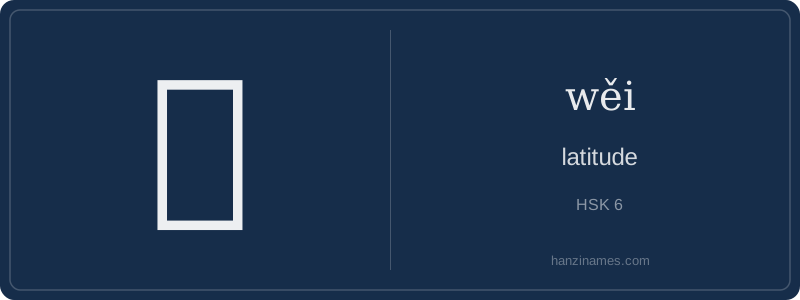
纬 is routinely used in modern Chinese in geography, navigation, and cartography—e.g., in weather reports (‘北纬39度’, běi wěi 39 dù, ‘39°N’), GPS interfaces, and school textbooks. It appears in the standard compound 经纬度 (jīngwěidù, ‘geographic coordinates’) and the idiom 经纬天下 (jīngwěi tiānxià), historically used in Han dynasty texts like the *Huainanzi* to describe sovereign mastery over territorial order.
The character evolved from the ancient ideograph 緯, combining the silk radical 纟 (indicating thread-weaving) with 韦 (wéi, originally meaning ‘tanned leather’ but here serving phonetically). Its earliest attested form appears in seal script (c. 3rd century BCE), consistently representing ‘transverse thread’—a literal weaving term later extended metaphorically to horizontal earth lines and scholarly ‘non-canonical’ texts (e.g., 纬书, wěishū, apocryphal commentaries on Confucian classics).
The character 纬 (wěi) embodies a profound spatial logic rooted in classical Chinese cosmology: just as warp threads (经, jīng) run vertically—symbolizing constancy, heaven, and the celestial meridian—latitude lines (纬) run horizontally, mirroring earthly cycles, seasonal change, and human cultivation. This duality reflects the ancient worldview where geography was not abstract measurement but embodied harmony between Heaven’s vertical order and Earth’s horizontal rhythm.
In imperial cartography and astronomy, 纬 denoted the ‘horizontal threads’ of the cosmos—parallels that structured star charts, agricultural calendars, and tributary diplomacy. Unlike Western latitude as pure geometry, 纬 carried ethical resonance: rulers were expected to ‘weave’ benevolent governance across latitudinal zones, ensuring harmony from north to south, much like weaving silk threads evenly across a loom.
Today, 纬 retains this layered meaning: it names geographic latitude in scientific contexts, yet also appears in terms like 纬度 (wěidù, ‘latitude’) and 经纬 (jīngwěi, ‘longitude and latitude’), evoking the inseparable unity of directional axes. Its presence in phrases like 经纬天地 (jīngwěi tiāndì, ‘to govern the realm’) reveals how mapping space remained inseparable from moral stewardship—a worldview where geography is always relational, rhythmic, and humane.
Example Sentences
Common Compounds
Similar Characters — Don't Mix These Up
Your First Step into Chinese Culture: Get a Chinese Name
Every journey into Chinese begins with a name. Use our free Chinese name generator to create a meaningful, personalized Chinese name that fits you perfectly.
Get My Chinese Name →