缚
Character Story & Explanation
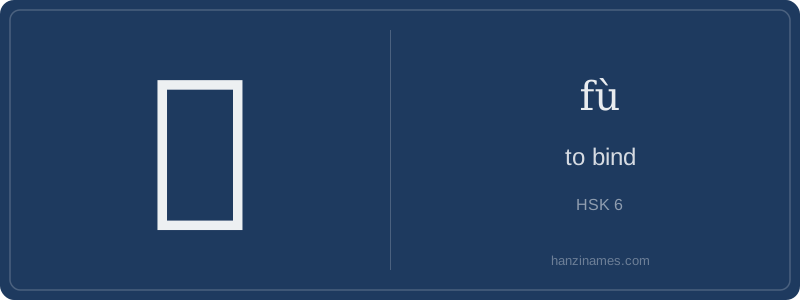
缚 appears frequently in formal, literary, and legal contexts — never in casual speech. It’s central to classical idioms like 作茧自缚 (zuò jiǎn zì fù, 'to bind oneself in one’s own cocoon'), a well-documented metaphor for self-imposed restriction, cited in Ming dynasty texts and still taught in middle-school Chinese curricula. Modern usage includes legal documents (e.g., '依法缚拿' — 'lawfully apprehend and restrain') and martial arts terminology ('缚手技', restraining techniques).
The character’s form has no pictographic origin; it’s a Han-era phono-semantic compound. In daily life, Chinese speakers encounter 缚 most often in written idioms or news reports about arrests — e.g., '警方缚获嫌犯' (police apprehended the suspect). Rarely spoken aloud, it’s recognized instantly in print as a marker of restraint, control, or entanglement.
As a linguistic detective, I begin with the radical: 纟 (sī), the ‘silk’ or ‘thread’ radical — a clear visual clue that 缚 relates to binding with cord, rope, or fabric. This radical appears in over 200 characters tied to textiles, tying, or constraint — from 红 (hóng, red, originally dyeing silk) to 维 (wéi, to maintain, as in ‘maintaining ties’). The presence of 纟 immediately signals physical or metaphorical connection through flexible material.
The right side, 博 (bó), is not phonetic in modern Mandarin but historically contributed sound and meaning. In early clerical script (c. 3rd century BCE–3rd century CE), 博 carried connotations of ‘broad’, ‘extensive’, and even ‘gambling’ — but here it functions primarily as a phonetic component, approximating the ancient pronunciation *pʰrak-s (reconstructed Old Chinese), which evolved into fù. Crucially, 博’s inclusion reflects standard Han-dynasty character formation: combining semantic (纟) and phonetic (博) elements.
Unlike pictographic characters like 日 (rì, sun), 缚 has no oracle-bone or bronze-inscription attestation — it first appears reliably in seal script (c. 221 BCE) and matured in Han clerical script. Its design isn’t literal imagery but systematic orthography: thread + sound. That makes it a textbook example of phono-semantic compound — the dominant category in Chinese writing. Its stability across 2,200 years underscores how efficiently this structure encodes both meaning and pronunciation.
Example Sentences
Common Compounds
Similar Characters — Don't Mix These Up
Your First Step into Chinese Culture: Get a Chinese Name
Every journey into Chinese begins with a name. Use our free Chinese name generator to create a meaningful, personalized Chinese name that fits you perfectly.
Get My Chinese Name →