缝
Character Story & Explanation
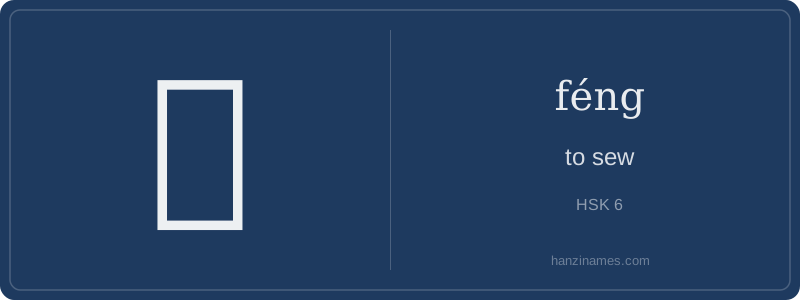
In daily life, 缝 appears frequently in practical contexts: clothing repair ('把扣子缝上' — 'sew the button back on'), medical instructions ('伤口需要缝合' — 'the wound needs suturing'), and idioms like 拆东墙补西墙 (‘dismantle the east wall to mend the west’ — patching problems haphazardly). It’s also common in formal writing: official documents use 缝合 for surgical sutures, and news reports cite 缝纫机 (sewing machines) in garment factory inspections. Historically, the term appears in Ming-dynasty textile manuals and Qing legal codes regulating tailoring guilds.
The character’s form derives from the silk radical 纟 (indicating thread-related meaning) and the phonetic component 逢 (féng, 'to meet'), suggesting the idea of 'thread meeting thread' — a documented semantic-phonetic compound (xíngshēng zì) first attested in seal script (c. 3rd c. BCE). No oracle bone form survives; its earliest verified shape is in Qin bamboo slips (221–206 BCE), consistently showing the 纟 + 逢 structure.
The Chinese character 缝 (féng) primarily means 'to sew'—a precise, manual act of joining fabric with needle and thread. Unlike English 'sew', which covers both hand and machine stitching, 缝 emphasizes intentional, skilled hand-sewing, often implying care or repair. Its dual pronunciation reflects semantic specialization: féng is the verb 'to sew'; fèng is the noun 'seam' or 'crack'. This phonetic duality mirrors English homographs like 'tear' (rip vs. cry), but here tone alone distinguishes action from object—a feature central to Mandarin’s tonal grammar.
Historically, 缝 belonged to textile culture vital in pre-industrial China, where mending clothes extended garment life and reflected frugality and virtue. In contrast, Western sewing traditions—like European embroidery guilds or American quilting bees—often emphasized artistry or community, while 缝 in classical texts (e.g., *Mencius*) appears in moral metaphors: 'mending societal rifts' (缝合裂痕). This imbues the character with subtle ethical weight beyond craft.
Culturally, 缝 resists direct equivalence with Western 'sew'. While a French *couturière* or German *Schneiderin* denotes a professional tailor, 缝 rarely implies occupational identity—it’s an everyday verb used by anyone repairing a button or hemming pants. Even in modern China, where fast fashion dominates, parents still teach children to 缝 on school uniforms, preserving intergenerational skill transmission rare in many Western contexts where sewing is now largely hobbyist or vocational.
Example Sentences
Common Compounds
Similar Characters — Don't Mix These Up
Your First Step into Chinese Culture: Get a Chinese Name
Every journey into Chinese begins with a name. Use our free Chinese name generator to create a meaningful, personalized Chinese name that fits you perfectly.
Get My Chinese Name →