罢
Character Story & Explanation
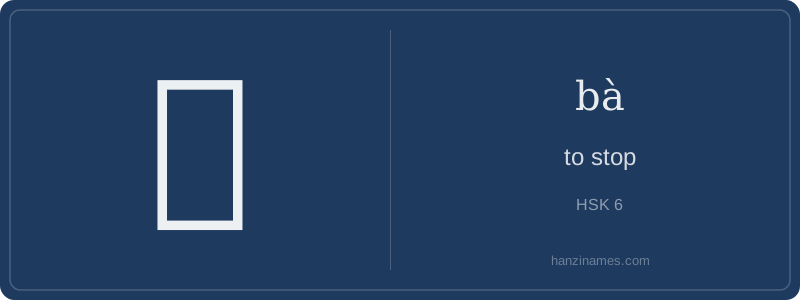
In modern Chinese, 罢 appears most frequently in formal, written, or legal contexts: government announcements (e.g., '罢工' bàgōng, 'strike'), historical narratives ('罢相' bàxiàng, 'dismissal of a chancellor'), and fixed idioms like '既往不咎,罢战言和' ('past grievances forgiven, cease hostilities and make peace'). It's rare in casual speech—replaced by 停 (tíng) or 结束 (jiéshù). The HSK 6-level usage reflects its register-specific precision: learners encounter it in news reports, legal texts, or classical allusions—not in café conversations.
The character evolved from seal script where 罒 (a stylized net) crowned '去' (to depart), visually encoding 'binding departure.' No oracle bone form survives, but bronze inscriptions (c. 1000 BCE) confirm its use for official removal. Today, Chinese people see 罢 primarily in headlines: '某官员被罢职' ('An official was dismissed from post')—a phrase carrying unmistakable gravity and finality.
Unearthing 罢 from bronze inscriptions and early Han texts reveals it was never a simple 'stop'—it carried the weight of formal cessation: dismissal from office, termination of ritual, or judicial exoneration. Its earliest attestations in excavated legal bamboo slips (e.g., Shuihudi Qin documents, 3rd c. BCE) show 罢 used in administrative decrees—'罢免' (bàmiǎn) meaning 'to dismiss an official'—reflecting state power to revoke authority. This wasn’t casual halting; it was institutional finality, etched in ink on bamboo.
The radical 罒 (originally 网 wǎng, 'net') signals containment or binding—suggesting that stopping here is deliberate, even coercive. Unlike 自然停止 (zìrán tíngzhǐ, 'natural stop'), 罢 implies an agent’s decisive action: a magistrate pronouncing judgment, a king revoking a decree. Its ten strokes form a compact yet authoritative shape—each stroke measured, like a seal pressed into clay. The lower '去' (qù, 'to depart') reinforces irrevocability: once 罢, there is no return path.
Over centuries, 罷 softened semantically but retained its bureaucratic gravity. In Tang poetry, it appears in lines like '事罢拂衣去' ('After affairs conclude, I brush my robe and leave')—evoking dignified withdrawal. Even today, it resists colloquial diminishment: you wouldn’t say 罢 for 'pausing a video.' It remains reserved for formal, consequential endings—court rulings, policy terminations, or ceremonial closures—preserving its ancient resonance as sanctioned, irreversible cessation.
Example Sentences
Common Compounds
Similar Characters — Don't Mix These Up
Your First Step into Chinese Culture: Get a Chinese Name
Every journey into Chinese begins with a name. Use our free Chinese name generator to create a meaningful, personalized Chinese name that fits you perfectly.
Get My Chinese Name →