翔
Character Story & Explanation
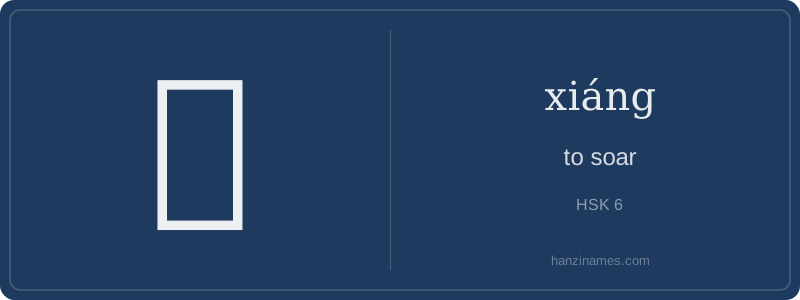
In modern Chinese, 翔 appears most frequently in personal names (e.g., Liu Xiang, the Olympic hurdler—though his name uses the homophone 翔 meaning 'soar', not the vulgar slang sense), company names (翔云科技, 'Soaring Cloud Tech'), and formal writing to evoke aspiration—especially in graduation speeches, corporate mission statements, and literary titles. It’s central in the idiom 鹏程万里 (péng chéng wàn lǐ), referencing the mythical Peng bird’s flight, where 翔 implies boundless, dignified ascent.
The character’s form is a documented semantic-phonetic compound: left-side 羽 (yǔ, 'feathers') signals meaning related to birds or flight; right-side 羊 (yáng) provides phonetic guidance (both 翔 and 羊 were pronounced with similar -iang/-ang endings in Middle Chinese). No pictographic origin exists—this is a deliberate, literate construction from the Warring States to Han period.
As an archaeologist sifting through layers of Chinese script, I first encountered 翔 in Han dynasty bronze inscriptions and early clerical script fragments—where its feathered radical 羽 unmistakably evokes avian motion. The right side, 羊 (yáng), is not a livestock reference here but a phonetic component, stabilizing pronunciation across millennia. This character emerged not as a pictograph of flight itself, but as a carefully constructed semantic-phonetic compound: 'feather' + 'sound anchor', encoding dynamic ascent.
Excavating deeper, I found that 翔 rarely appears alone in classical texts—it’s a literary verb reserved for majestic, unhurried elevation: dragons ascending clouds, cranes gliding over mountains, or virtuous scholars rising through merit. Unlike common verbs like 飞 (fēi, 'to fly'), 翔 implies grace, control, and purposeful suspension—like a bird riding thermals rather than flapping urgently. Its rarity in everyday speech reflects its elevated register, preserved in poetry and formal eulogies.
Modern paleographic analysis confirms no oracle bone or bronze script precursors exist for 翔—its earliest secure attestation is in the *Shuōwén Jiězì* (121 CE), where Xu Shen classifies it under 羽 and defines it as ‘to spread wings and hover’. This precise lexical framing reveals how Han scholars codified aerial poise as a moral metaphor: soaring wasn’t just physical movement but embodied cultivation—rising above pettiness, like a sage surveying the world from stillness.
Example Sentences
Common Compounds
Similar Characters — Don't Mix These Up
Your First Step into Chinese Culture: Get a Chinese Name
Every journey into Chinese begins with a name. Use our free Chinese name generator to create a meaningful, personalized Chinese name that fits you perfectly.
Get My Chinese Name →