翘
Character Story & Explanation
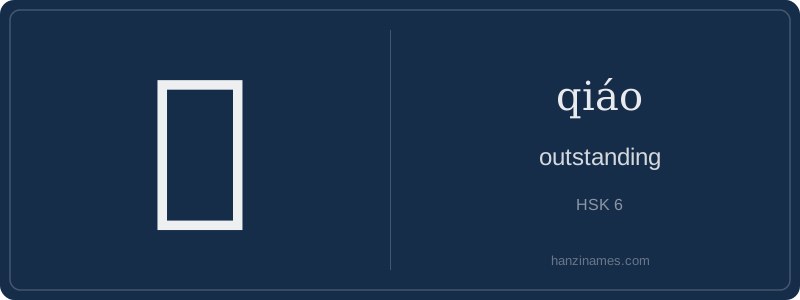
In modern Chinese, 翘 appears most frequently in the idiom 翘楚 (qiáochǔ), meaning 'an outstanding person or thing'—originally referring to the tallest treetop (楚) among a grove, now used in formal writing, news headlines, and academic commendations (e.g., '行业翘楚' — 'a trailblazer in the industry'). It also survives in colloquial verbs like 翘课 (qiàokè, 'to skip class'), where qiào reflects physical 'lifting away'—a documented shift attested in 20th-century student slang.
The character’s form is not pictographic but phono-semantic: 羽 (yǔ, 'feather') is the semantic radical, suggesting lightness or elevation; the phonetic component is 尧 (yáo), which approximates the ancient pronunciation *ŋraw. No oracle bone or bronze script forms exist for 翘—it first appears in clerical script during the Han dynasty, confirming its relatively late emergence in the written record.
As an archaeologist sifting through layers of linguistic sediment, I find 翘 (qiáo) not carved on oracle bones—but emerging in Han dynasty texts as a dynamic verb meaning 'to lift up' or 'to raise', its feather radical (羽) evoking upward motion, like wings tilting skyward. The character’s earliest attestations appear in medical and astronomical contexts, where it describes the subtle elevation of qi or celestial bodies—hinting at a conceptual link between physical posture and moral or intellectual ascendancy.
By the Tang and Song dynasties, 翘 had fossilized into a metaphorical marker of excellence: someone who 'stands out' not just physically but morally or talent-wise. Its dual pronunciation—qiáo (for excellence) and qiào (for physical lifting/tilting)—reveals a semantic split: one path ascends into abstraction (outstanding), the other remains anchored in kinaesthetics (a raised chin, a cocked eyebrow). This duality mirrors how classical Chinese often derives abstract virtues from embodied gestures.
Modern excavations of usage show 翘 rarely stands alone; it thrives in compounds and idioms where its ‘upward’ energy is harnessed for praise or irony. Unlike static adjectives like 优秀 (yōuxiù), 翘 carries subtle connotation of effortless distinction—like a crane’s neck arching above the reeds. Its HSK 6 status reflects its lexical sophistication: not basic vocabulary, but a refined brushstroke in expressive nuance, reserved for literary critique, elite education discourse, or wry self-deprecation.
Example Sentences
Common Compounds
Similar Characters — Don't Mix These Up
Your First Step into Chinese Culture: Get a Chinese Name
Every journey into Chinese begins with a name. Use our free Chinese name generator to create a meaningful, personalized Chinese name that fits you perfectly.
Get My Chinese Name →