翼
Character Story & Explanation
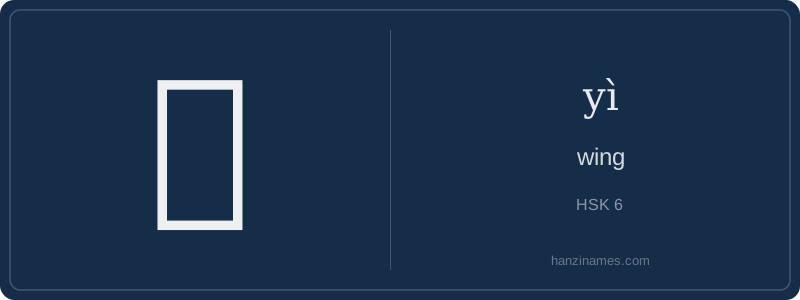
In daily modern Chinese, 翼 appears mainly in political, military, and technical terms — such as 左翼 (zuǒ yì, 'left wing'), 右翼 (yòu yì, 'right wing'), or 機翼 (jī yì, 'airplane wing'). It's also in the idiom 如虎添翼 (rú hǔ tiān yì, 'like adding wings to a tiger'), meaning 'to greatly strengthen an already powerful force'. Historically, it appears frequently in the *Zuo Zhuan* and other Warring States texts to denote 'flank' or 'supporting force' in battle formations.
The character’s form is not a pictograph of a wing but a phono-semantic compound: the top and bottom 羽 radicals emphasize meaning ('feather/wing'), while the middle component 異 (yì) provides phonetic guidance. This structure has been stable since the seal script era (c. 3rd century BCE), confirmed by excavated bamboo manuscripts from the Chu state.
Hello students! The character 翼 (yì) is a beautiful and historically rich character. At first glance, you’ll notice its radical 羽 (yǔ), meaning 'feather' or 'wing' — which gives a strong visual clue about its original meaning: 'wing'. Indeed, in classical Chinese, 翼 commonly meant 'wing', 'side', or 'support', like the wings of a bird or the flanks of an army. It’s also used metaphorically for protection or assistance — think of someone being 'a wing' to another person.
This character appears in many literary and formal contexts, especially in idioms and historical texts. Though it’s HSK Level 6 (advanced), you’ll encounter it most often not as a standalone word, but within compound words like 左翼 (zuǒ yì, 'left wing') or 右翼 (yòu yì, 'right wing'), where it carries political or strategic connotations. Its 17-stroke structure may seem daunting, but breaking it down into components — two 'feathers' (羽) framing a central '異' (yì, 'different') — makes memorization easier.
Now, about that note on 'alternative name for 絳': this is a *very* specific, rare usage found only in ancient geographical texts. 絳 (jiàng) was the capital of the Jin State during the Spring and Autumn period, and some classical commentaries (e.g., Du Yu’s annotations to the *Zuo Zhuan*) occasionally refer to it as 翼 — but this is archaic, scholarly, and *not* used in modern speech or writing. Don’t confuse it with the primary meaning — focus first on 'wing' and its extended senses.
Example Sentences
Common Compounds
Similar Characters — Don't Mix These Up
Your First Step into Chinese Culture: Get a Chinese Name
Every journey into Chinese begins with a name. Use our free Chinese name generator to create a meaningful, personalized Chinese name that fits you perfectly.
Get My Chinese Name →