耕
Character Story & Explanation
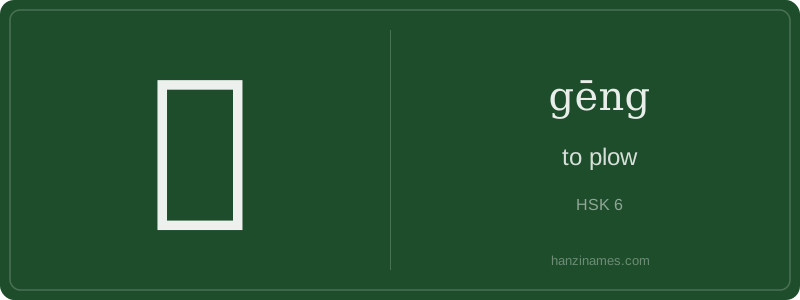
耕 remains deeply embedded in modern Chinese policy, education, and idioms. It appears in official terms like 耕地保护 (gēngdì bǎohù, 'arable land protection'), a cornerstone of China’s farmland red-line policy enforced since 1998. The idiom 男耕女织 (nán gēng nǚ zhī, 'men plow, women weave') is taught in middle-school textbooks as a classic depiction of premodern gendered labor. Historical records from the *Records of the Grand Historian* (c. 94 BCE) document imperial 'plowing ceremonies' where emperors symbolically broke ground each spring — a ritual revived in Beijing’s Altar of Agriculture in 2005.
The character’s origin is documented: 耒 is a clear pictograph of a Neolithic plow, confirmed by oracle bone and bronze inscriptions showing its forked-tine shape. 耕 itself first appears in Warring States bamboo texts (475–221 BCE) as a compound combining this tool radical with 井 for sound — not meaning — aligning with standard phono-semantic formation rules verified by paleographers like Qiu Xigui.
Our investigation begins with the radical 耒 (lěi), an ancient pictograph of a farming tool — specifically, a wooden plow with a curved handle and pronged tip used in Shang and Zhou dynasty agriculture. This radical appears in all characters related to tilling, sowing, and cultivation, anchoring 耕 firmly in China’s agrarian roots. The right side, 井 (jǐng), originally depicted a well or irrigation grid — not a literal well here, but a phonetic component that evolved to signal pronunciation while subtly reinforcing the idea of organized, methodical land use.
Historically, 耕 wasn’t just about turning soil — it embodied moral and philosophical duty. Confucian texts like the *Book of Rites* linked diligent plowing with filial piety and social order: 'He who does not耕 fails his ancestors.' During the Han dynasty, state granaries tracked '耕地' (arable land) as a key metric of national strength. Even today, the character carries ethical weight — to耕 is to invest labor with purpose, echoing the classical ideal of 'working the land to cultivate virtue.'
Graphically, 耕 stabilized by the late Qin bamboo slips and Han clerical script, shedding earlier asymmetries. Its 10-stroke structure balances semantic clarity (耒) and phonetic guidance (井). Unlike purely abstract characters, 耕 retains tangible agrarian logic: no stroke is decorative — each reflects tool geometry or action flow. This functional integrity explains its endurance across 2,300+ years of written Chinese, surviving script reforms precisely because its form and meaning co-evolved without contradiction.
Example Sentences
Common Compounds
Similar Characters — Don't Mix These Up
Your First Step into Chinese Culture: Get a Chinese Name
Every journey into Chinese begins with a name. Use our free Chinese name generator to create a meaningful, personalized Chinese name that fits you perfectly.
Get My Chinese Name →