耸
Character Story & Explanation
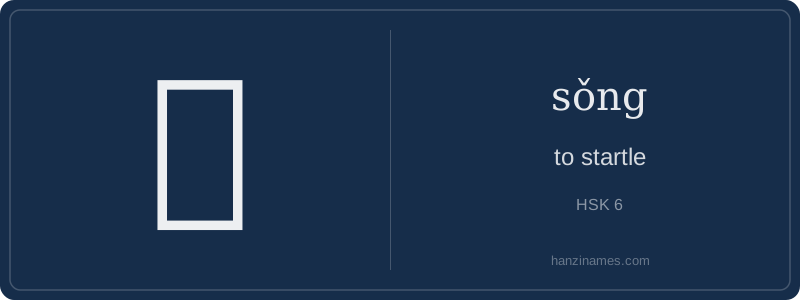
In modern Mandarin, 耸 is rarely used independently but appears frequently in formal and literary contexts to convey intense, visible reactions—especially in journalism, historical narratives, and idiomatic expressions. A well-documented phrase is 耸人听闻 (sǒng rén tīng wén), meaning 'to shock or alarm people with sensational reports', widely attested in People’s Daily archives since the 1950s. Another common collocation is 耸立 (sǒnglì), 'to tower' or 'stand tall and imposing', used for mountains, monuments, and skyscrapers—reflecting its core sense of upward projection and prominence.
The character’s form has no oracle-bone or bronze script attestation; it first appears clearly in seal script (c. 3rd century BCE), composed of 耳 (ear, semantic hinting at alertness/reception) and 从 (cóng, phonetic and possibly evoking 'gathering upward'). While not pictographic, its dual-person top (two 人) visually reinforces verticality and collective intensity—a documented structural motif in Warring States-era character formation.
As a linguistic detective, I begin at the scene: the character 耸 (sǒng), with its 10 strokes and ear radical (耳). At first glance, the ear may seem misleading—after all, ‘to excite’ isn’t auditory. But ancient Chinese often linked heightened awareness with bodily reactions: ears pricking up, hair standing on end, shoulders lifting in alarm or awe. The upper part, 从 (cóng), originally meant ‘to follow’ or ‘to gather’, but here it evolved into a phonetic component and visual echo of upward movement—two people (人+人) stacked, suggesting collective rising intensity.
The character’s structure tells a story of physiological arousal: the ear radical hints not at hearing per se, but at alertness—the body’s first response to startling news or awe-inspiring sights. In classical texts like the *Zuo Zhuan*, 耸 appears in phrases like ‘耸然’ (sǒngrán), describing sudden, visceral reactions—like a minister gasping upright upon hearing imperial edicts. This isn’t passive listening; it’s embodied excitement, where cognition and posture fuse.
Modern usage retains this kinetic energy: 耸 never stands alone as a verb meaning ‘to excite’—it’s always embedded in compound verbs or adjectives expressing *intensified reaction*. It’s the linguistic equivalent of a raised eyebrow, a sharp inhale, or shoulders jerking upward. Its power lies in implication, not declaration: you don’t ‘excite’ someone with 耸—you cause them to *react visibly*. That’s why it thrives in literary and journalistic registers: precise, economical, and deeply physical—proof that Chinese characters encode not just meaning, but posture, pulse, and presence.
Example Sentences
Common Compounds
Similar Characters — Don't Mix These Up
Your First Step into Chinese Culture: Get a Chinese Name
Every journey into Chinese begins with a name. Use our free Chinese name generator to create a meaningful, personalized Chinese name that fits you perfectly.
Get My Chinese Name →