胎
Character Story & Explanation
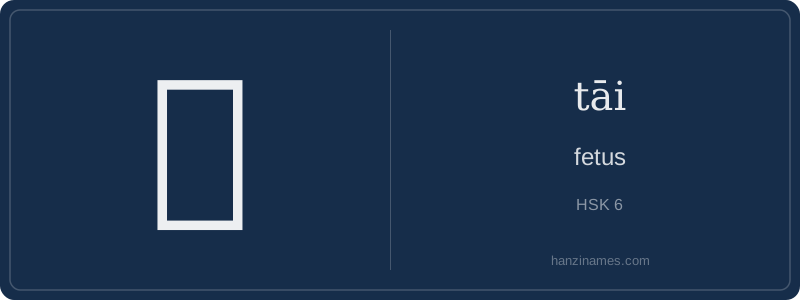
In modern Chinese, 胎 most commonly appears in medical, legal, and educational contexts: prenatal care (胎期保健), abortion regulations (人工流产涉及胎儿), and the widely practiced tradition of 胎教 (tāijiào), supported by government health guidelines and mainstream parenting literature since the 1980s. It also features in idioms like 胎死腹中 (tāi sǐ fù zhōng, 'fetus dies in the womb'), used metaphorically for projects that fail before launch—a usage documented in Ming-dynasty vernacular fiction and still current in business journalism.
The character’s form is not pictographic but semantic-phonetic: ⺼ (flesh radical, indicating bodily origin) + 台 (tāi, phonetic component, also meaning 'platform' or 'base'). Its earliest attestation is in Han dynasty bamboo slips (c. 2nd century BCE), where it consistently denotes the developing human in utero—never abstract or mythic, always anatomical and clinical.
The character 胎 (tāi) embodies a profound Confucian and Daoist convergence: life as both sacred continuity and natural process. Rooted in the ⺼ (flesh/body) radical, it locates the fetus not as an abstract concept but as physically embedded—literally 'in the body’s matrix.' This reflects the classical Chinese view that personhood begins in relational embodiment, not isolated biology; the fetus is already part of the family lineage (zōng), tied to ancestral qi and maternal vitality.
Unlike Western dualisms separating mind/body or soul/matter, 胎 implies ontological unity: the fetus is not 'potential' life but *embodied becoming*—a dynamic stage in the continuous flow of qi and blood. Classical medical texts like the Huangdi Neijing describe fetal development in terms of yin-yang balance and organ-system resonance, reinforcing that life unfolds through relational harmony, not autonomous emergence.
This worldview extends metaphorically: 胎 appears in words like 胎教 (tāijiào, 'fetal education'), reflecting the millennia-old belief that moral and aesthetic cultivation begins *in utero* via maternal conduct, music, and environment. Thus, 胎 is never merely biological—it is cultural, ethical, and cosmological, anchoring human life within a web of interdependence stretching from ancestors to unborn generations.
Example Sentences
Common Compounds
Similar Characters — Don't Mix These Up
Your First Step into Chinese Culture: Get a Chinese Name
Every journey into Chinese begins with a name. Use our free Chinese name generator to create a meaningful, personalized Chinese name that fits you perfectly.
Get My Chinese Name →