胀
Character Story & Explanation
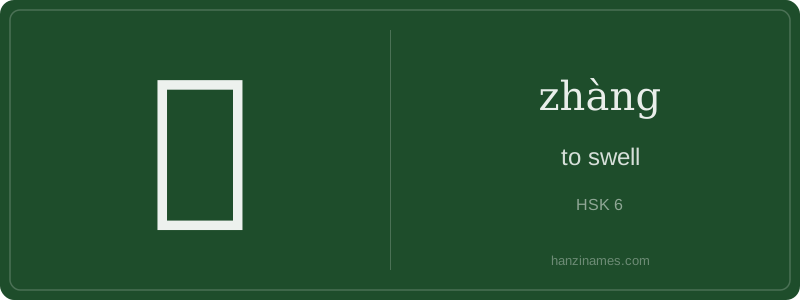
胀 is widely used in modern Mandarin to describe pathological or uncomfortable swelling—especially in medical contexts (e.g., 腹胀 fù zhàng, 'abdominal distension') and everyday complaints ('I feel bloated after dumplings'). It appears in the classical medical text *Huangdi Neijing* (c. 3rd century BCE–1st century CE), where 胀病 (zhàng bìng, 'distension disorders') are systematically categorized by affected organs and underlying yin-yang imbalances.
The character combines the radical ⺼ (‘flesh/body’) with 张 (zhāng, ‘to stretch, expand’)—a phonetic-semantic compound documented in the *Shuōwén Jiězì* (121 CE). Its form reflects Han dynasty understanding: physical expansion rooted in the body’s material reality, not abstract force.
The character 胀 (zhàng) embodies a profound Chinese understanding of bodily and cosmic balance: swelling is not merely physical change but a sign of internal disharmony—excess qi, dampness, or stagnation. In Traditional Chinese Medicine (TCM), 胴胀 (abdominal distension) signals disrupted zàng-fǔ organ function, reflecting the worldview that health arises from dynamic equilibrium, not static perfection.
This perspective extends beyond medicine into language and metaphor: to say 心胀 (xīn zhàng, 'heart swelling') conveys emotional overwhelm—not joy, but suffocating grief or unprocessed sorrow. Unlike English ‘swell’ (which can be positive, as in ‘swell music’), 胀 carries an inherent warning: expansion without regulation risks rupture, imbalance, or decay.
Culturally, 胀 reveals how Chinese thought treats change as relational and contextual. A river swelling (河水胀, hé shuǐ zhàng) may bring life or flood; rice grains swelling (米粒胀, mǐ lì zhàng) signal cooking success—or spoilage if over-hydrated. There is no neutral ‘swelling’—only meaningful, consequential expansion within a web of cause, condition, and consequence.
Example Sentences
Common Compounds
Similar Characters — Don't Mix These Up
Your First Step into Chinese Culture: Get a Chinese Name
Every journey into Chinese begins with a name. Use our free Chinese name generator to create a meaningful, personalized Chinese name that fits you perfectly.
Get My Chinese Name →