腔
Character Story & Explanation
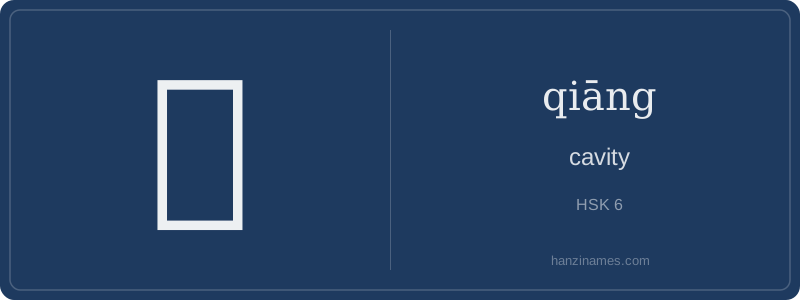
In daily life, 腔 most commonly appears in medical contexts (e.g., '胸腔积液' — pleural effusion) and performing arts ('京腔', '川腔' — regional opera styles). It’s central to the idiom '拿腔作调' (ná qiāng zuò diào), meaning 'to put on airs' or 'affect a pretentious tone', documented since the Qing dynasty in vernacular fiction like Officialdom Unmasked. Modern speakers use it reflexively when criticizing artificial speech—'别拿腔了!' ('Stop putting on that affected tone!').
The character is not pictographic; no oracle-bone or bronze inscriptions exist for 腔. It first appears reliably in Han-era bamboo slips as a semantic-phonetic compound: ⺼ (body/flesh) + 空 (empty/void), reflecting its anatomical function. Its form stabilized in clerical script—no disputed origins, just clear functional logic.
Our detective begins at the crime scene: the character 腔 (qiāng). At first glance, it’s a body radical ⺼—a clue pointing to anatomy—and the right side ‘空’ (kōng), meaning 'empty' or 'void'. This isn’t coincidence: in ancient Chinese medical texts like the Huangdi Neijing, 'cavity' referred to hollow spaces within the body—thoracic, abdominal, cranial—that housed vital organs and qi. The compound structure is semantic-phonetic: ⺼ signals bodily relevance; 空 hints both at meaning (emptiness → cavity) and sound (kōng shares phonetic kinship with qiāng in Middle Chinese).
Zooming in on historical usage, 腔 appears early in Han dynasty medical manuscripts and Tang poetry—not as a standalone noun for 'hole', but as part of technical terms like '胸腔' (chest cavity) and '腹腔' (abdominal cavity). Its phonetic component 空 was likely chosen not only for sound but also conceptual resonance: a cavity is literally an *empty space within flesh*. No oracle-bone or bronze script forms survive for 腔—it emerged later, during the clerical script era, when anatomical terminology formalized alongside acupuncture theory.
The modern twist? While 'cavity' remains its core anatomical meaning, 腔 has evolved linguistically into a powerful metaphor. In performing arts, it denotes vocal timbre and regional singing style—e.g., '京腔' (Peking opera vocal style)—extending the idea of a resonant, shaped space. This semantic drift reflects how Chinese characters often bridge physiology and culture: the body’s hollows become vessels for voice, identity, and tradition. Our detective concludes: 腔 is less about emptiness than about *functionally defined space*—whether holding lungs or holding melody.
Example Sentences
Common Compounds
Similar Characters — Don't Mix These Up
Your First Step into Chinese Culture: Get a Chinese Name
Every journey into Chinese begins with a name. Use our free Chinese name generator to create a meaningful, personalized Chinese name that fits you perfectly.
Get My Chinese Name →