腹
Character Story & Explanation
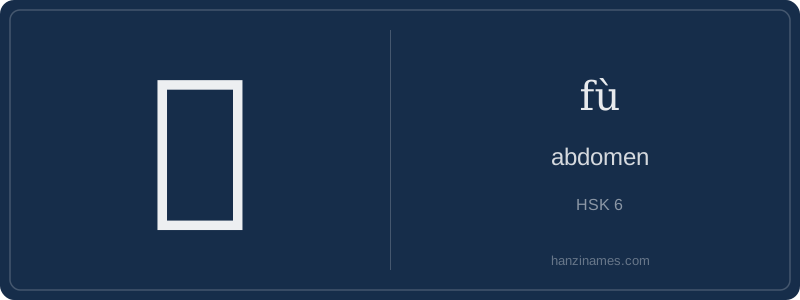
腹 appears frequently in Classical and modern Chinese across medical, literary, and colloquial registers. In Traditional Chinese Medicine texts like the Huangdi Neijing, 腹 denotes the abdominal region in diagnostic contexts (e.g., ‘腹痛’—abdominal pain). Common idioms include ‘满腹经纶’ (mǎn fù jīng lún), meaning ‘a belly full of strategic knowledge’, used since the Ming dynasty to praise erudition. It also features in everyday expressions like ‘空腹’ (kōng fù, ‘on an empty stomach’), regulated in public health advisories.
Graphically, 腹 is a phono-semantic compound: radical ⺼ (flesh) on the left signals bodily reference; right component 复 (fù) provides sound and conceptual nuance—‘repetition’ or ‘return’, mirroring digestive cycles and the abdomen’s role in assimilation and renewal. No oracle-bone form survives, but its seal-script form (c. 3rd c. BCE) already shows this structure, confirming its early semantic logic.
The character 腹 (fù) embodies a profound integration of physiology and philosophy in traditional Chinese thought. Unlike Western anatomical terms that isolate body parts, 腹 signifies not just the physical abdomen but also the seat of intuition, emotional resonance, and vital qi accumulation—reflected in concepts like ‘腹有诗书气自华’ (‘One’s abdomen holds poetry and learning, and grace naturally shines forth’). This metaphorical extension reveals how classical Chinese culture locates wisdom and moral cultivation within the body itself.
In Daoist and medical traditions, the lower abdomen (especially the dantian) is revered as the body’s energetic core—the wellspring of life force, stability, and spiritual grounding. 腹 thus bridges visceral reality and metaphysical function: it is where food transforms into qi, where emotions settle before rising as speech or action, and where stillness births insight. This holistic view rejects mind–body dualism, treating the abdomen as both vessel and vital organ of being.
Even linguistically, 腹 resists reduction to mere anatomy. Its radical ⺼ (flesh/bone) anchors it in the corporeal, yet its phonetic component 复 (fù, meaning ‘to repeat’, ‘to return’) subtly evokes cyclical processes—digestion, breath, renewal—echoing the Confucian ideal of self-cultivation as iterative, embodied practice. To speak of 腹 is to invoke rhythm, depth, and quiet potency—a cultural lens through which inner fullness, not outward display, defines true substance.
Example Sentences
Common Compounds
Similar Characters — Don't Mix These Up
Your First Step into Chinese Culture: Get a Chinese Name
Every journey into Chinese begins with a name. Use our free Chinese name generator to create a meaningful, personalized Chinese name that fits you perfectly.
Get My Chinese Name →