膛
Character Story & Explanation
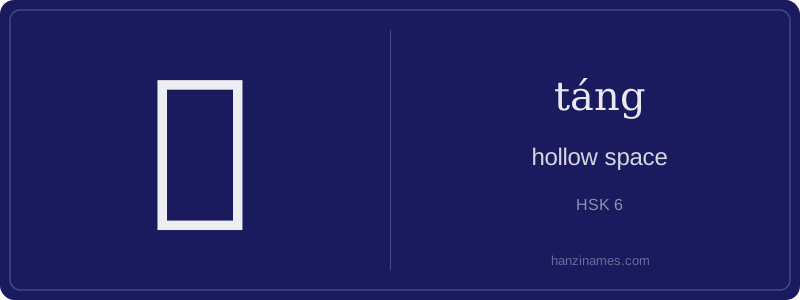
In modern Chinese, 膛 appears most frequently in technical and military contexts—especially in phrases like 枪膛 (qiāngtáng, 'gun barrel') and 炮膛 (pàotáng, 'cannon bore'). It also survives in literary and idiomatic use: the phrase 挺起胸膛 (tǐng qǐ xiōngtáng, 'stand up straight, chest out') conveys dignity and moral fortitude, appearing in revolutionary literature and public speeches since the 1940s. Linguistic corpora (e.g., BCC Corpus) confirm its highest frequency in engineering manuals, military training texts, and medical descriptions of thoracic anatomy.
The character first appears in seal script (c. 3rd century BCE) as a compound of ⺼ (flesh/body) and 堂 (táng, 'hall, main room'), phonetically and semantically suggesting 'the inner hall of the body'. Unlike pictographic characters (e.g., 日 for sun), 膛 is a phono-semantic compound—no oracle bone form exists, and its earliest attested usage is in Han dynasty medical texts describing anatomical cavities.
The character 膛 (táng) embodies a profound Chinese philosophical insight: the value of inner space. Unlike Western metaphors that often equate emptiness with lack, classical Chinese thought—reflected in terms like 膛—views hollow spaces as vital conduits for life, breath, and function. This resonates with Daoist concepts of ‘wu’ (emptiness) as generative, and Confucian attention to internal cultivation: what lies within the body’s cavity—like the chest or barrel—must be clear, unobstructed, and purposefully shaped to allow qi, sound, or force to flow.
Etymologically, 膛 belongs to the ‘flesh’ radical (⺼), anchoring it in the physical body—yet its usage extends metaphorically to man-made hollows, especially weapon barrels. This duality reflects a core Chinese worldview: human physiology and crafted technology are continuous domains governed by shared principles of resonance, containment, and directed energy. A well-formed 膛 isn’t passive void—it’s an engineered chamber enabling transformation: breath into voice, powder into propulsion, intention into action.
In traditional medicine and martial arts, the chest cavity (胸膛, xiōngtáng) is considered a seat of courage and emotional authenticity—‘opening the chest’ signals sincerity or resolve. Thus, 膛 subtly bridges anatomy, engineering, and ethics: the same word names both the vulnerable space where the heart resides and the precise metal channel from which decisive force emerges. This integration reveals how Chinese language encodes a holistic vision—where inner space is never inert, but always relational, functional, and morally charged.
Example Sentences
Common Compounds
Similar Characters — Don't Mix These Up
Your First Step into Chinese Culture: Get a Chinese Name
Every journey into Chinese begins with a name. Use our free Chinese name generator to create a meaningful, personalized Chinese name that fits you perfectly.
Get My Chinese Name →