已
Character Story & Explanation
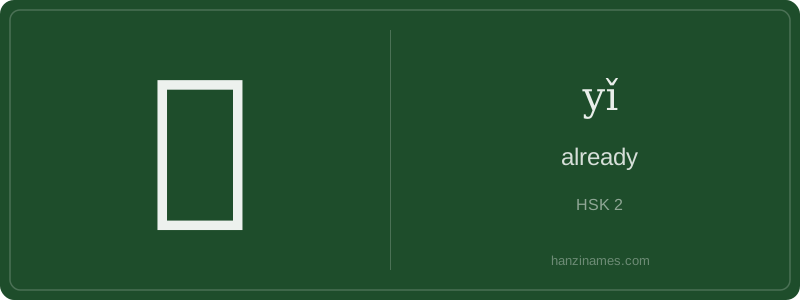
In daily life, 已 is ubiquitous in written Chinese — especially in official, digital, and administrative contexts. It appears in standardized phrases like 已读 (yǐ dú, 'read receipt' in messaging apps) and 已发货 (yǐ fāhuò, 'item shipped'), reflecting China’s highly digitized service economy. The phrase 已经 (yǐjīng), meaning 'already', is among the top 20 most frequent adverbs in HSK Level 2 textbooks and spoken corpora (Beijing Language and Culture University, 2022).
The character 已 evolved from the ancient form of 己 (jǐ, 'self'), with its top stroke extended upward and rightward to distinguish it graphically. Unlike pictographic characters (e.g., 日 for 'sun'), 已 has no concrete object reference — it’s a semantic derivative, repurposed early in the Warring States period (475–221 BCE) as an aspectual marker for completed action, as confirmed by excavated bamboo slips from Shuihudi.
Imagine rushing through Beijing’s bustling Guomao subway station at 8:15 a.m. — you’re late for work, heart pounding, scanning the departure board. Then you spot it: ‘Line 10 → Sihui — 已发车’ (yǐ fāchē). Your shoulders relax. ‘Already departed’ means you just missed it — but also that the system is running precisely, reliably, on time. That tiny three-stroke character 已 carries immense temporal weight: it marks irreversible completion, a point of no return in time’s flow.
Unlike English ‘already’, which often conveys surprise or impatience (‘You’ve finished already?’), 已 is neutral and factual — a grammatical marker anchoring actions firmly in the completed past. It appears before verbs in perfective constructions, never after. Its austerity reflects classical Chinese concision: no extra syllables, no inflections — just certainty carved in ink.
As a native speaker told me while sipping jasmine tea in a Suzhou teahouse: ‘If 是 is the door to truth, 已 is the lock that clicks shut on what has happened.’ It’s indispensable in formal writing, news reports, and digital interfaces — from hospital appointment confirmations (‘预约已成功’) to WeChat payment receipts (‘支付已确认’). Its brevity makes it ideal for space-constrained contexts where clarity trumps flourish.
Example Sentences
Common Compounds
Similar Characters — Don't Mix These Up
Your First Step into Chinese Culture: Get a Chinese Name
Every journey into Chinese begins with a name. Use our free Chinese name generator to create a meaningful, personalized Chinese name that fits you perfectly.
Get My Chinese Name →