希
Character Story & Explanation
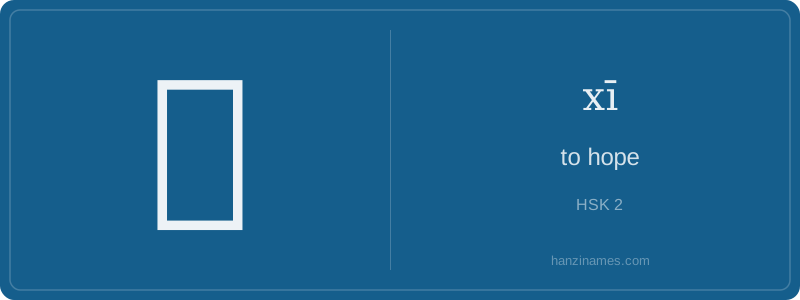
希 is ubiquitous in modern Chinese: it appears in HSK 2 vocabulary, official slogans (e.g., 中国梦,人民对美好生活的向往就是我们的奋斗目标—‘The people’s hope for a better life is our mission’), and daily expressions like 我希望 (wǒ xīwàng, ‘I hope’). It’s central in idioms such as 希冀未来 (xī jì wèilái, ‘to look forward to the future’) and the classical phrase 希世之宝 (xī shì zhī bǎo, ‘a rare treasure’), attested in the *Book of Han* (1st c. CE).
The character’s origin is documented in bronze inscriptions and *Shuōwén Jiězì* (121 CE): it’s a phonosemantic compound, with 巾 as the radical (likely indicating an early association with ceremonial cloth used in oaths or vows) and 稀 (now obsolete in this role) as the phonetic component. No oracle bone form survives—its earliest confirmed form is in Warring States bamboo slips, consistently written with 巾 + 稀-like element.
As a linguistic detective, I begin at the scene of the crime—the earliest reliable inscriptions. 希 appears in seal script (c. 3rd century BCE) with a clear structure: 巾 (cloth radical) on the left and 稀 (xī, 'rare')—later simplified—on the right. Contrary to folk etymology, it was never a pictograph of hope itself; rather, it borrowed phonetic value from 稀 while acquiring semantic nuance through usage: what is rare is often hoped-for. This phonosemantic compound reflects Classical Chinese’s pragmatic orthographic logic—not poetic symbolism, but functional borrowing.
The radical 巾 (jīn, 'cloth') seems puzzling for 'hope'—until we consider historical context. In ancient texts like the *Zuo Zhuan*, 希 appears in ritual and administrative records meaning 'rarely', 'seldom', then gradually shifts toward 'longed-for rarity': a scarce harvest, a rare virtuous ruler—hence 'to hope'. By the Han dynasty, it’s firmly lexicalized as a verb meaning 'to wish for', appearing in phrases like 希冀 (xī jì), where both characters reinforce aspiration. Its semantic drift mirrors how scarcity fuels desire—a cognitive universal encoded in script.
Modern standardization cemented 希 in 1956’s *First List of Simplified Characters*, retaining its 7-stroke form. The stroke order—horizontal, vertical, horizontal fold, dot, vertical, horizontal, vertical—creates rhythmic balance: the 巾 radical anchors the left with stability, while the right side’s open space (especially the final falling stroke) subtly evokes openness, anticipation. Though not pictorial, its calligraphic flow embodies intentionality: the writer’s brush moves deliberately toward resolution, mirroring the act of hoping itself—structured yet forward-looking, grounded but aspirational.
Example Sentences
Common Compounds
Similar Characters — Don't Mix These Up
Your First Step into Chinese Culture: Get a Chinese Name
Every journey into Chinese begins with a name. Use our free Chinese name generator to create a meaningful, personalized Chinese name that fits you perfectly.
Get My Chinese Name →