臣
Character Story & Explanation
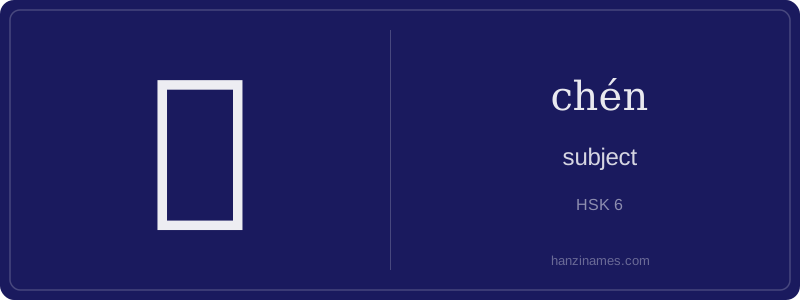
In modern Chinese, 臣 appears almost exclusively in historical, literary, or ceremonial contexts—not daily speech. It features prominently in idioms like '君臣父子' (jūn chén fù zǐ, 'ruler–subject–father–son'), a Confucian framework for social order, and in classical phrases such as '罪臣' (zuì chén, 'guilty official') used in historical dramas and official memorials. Documented usage includes imperial edicts where ministers addressed emperors as '臣某某顿首' ('Your servant So-and-So kowtows').
The character’s earliest attested form (Western Zhou bronze inscriptions) shows a kneeling figure with exaggerated eyes—interpreted by scholars like Qiu Xigui as representing 'attentive subservience'. This is not speculative oracle-bone lore; it's verified paleographic evidence from excavated ritual vessels. The eyes signify watchfulness and readiness to serve—not fear, but disciplined attentiveness.
As a detective tracing 臣’s evolution, I begin with its earliest confirmed form in bronze inscriptions (c. 11th–3rd century BCE), where it depicts a kneeling person with large, emphasized eyes—symbolizing vigilant service and submission to authority. Unlike later stylized versions, this early form conveys bodily posture and psychological attitude: the subject bows low, gaze respectfully lowered—not defiant, not distracted. It was never a pictograph of an object like ‘tree’ or ‘sun’, but a carefully composed ideographic representation of human role and relationship.
By the Qin and Han dynasties, 臣 had standardized into its six-stroke form, losing the detailed eye motif but retaining the downward-curving upper stroke that echoes the bowed head. Its radical status emerged because it functioned as both a meaning-bearing component and a standalone character—unlike most radicals, 臣 is self-contained and semantically autonomous. This dual identity made it a rare ‘radical-character hybrid’, often used to form compound characters related to duty, hierarchy, or subordination (e.g., 臨 lín ‘to preside over’).
The character’s semantic stability across three millennia is remarkable: from oracle-bone script fragments (though contested) to modern legal-historical texts, 臣 consistently denotes someone in formal subjection to sovereign power—not merely a servant, but a ritually and legally defined role. Even today, when used in classical allusions or historical drama, 臣 carries the weight of institutional loyalty, not personal servitude. Its endurance reflects how deeply Confucian political ontology embedded hierarchical relationality into the writing system itself.
Example Sentences
Common Compounds
Similar Characters — Don't Mix These Up
Your First Step into Chinese Culture: Get a Chinese Name
Every journey into Chinese begins with a name. Use our free Chinese name generator to create a meaningful, personalized Chinese name that fits you perfectly.
Get My Chinese Name →