舌
Character Story & Explanation
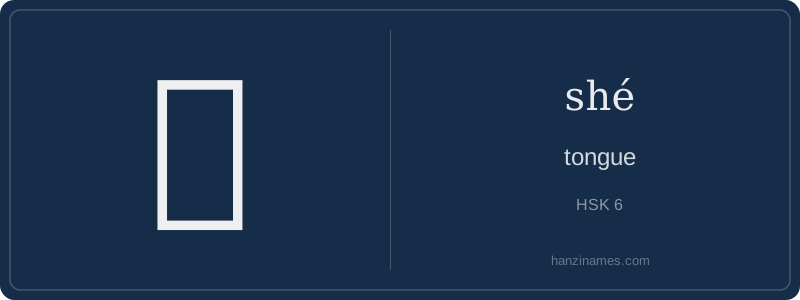
舌 is indispensable in Traditional Chinese Medicine (TCM), where practitioners examine tongue color, coating, and shape to diagnose internal imbalances—a documented clinical practice since the Han dynasty. It also anchors common idioms: ‘巧舌如簧’ (qiǎo shé rú huáng, 'a clever tongue like a reed pipe') describes persuasive, even deceitful, speech—first recorded in the Book of Rites. In daily life, it appears in food terms (e.g., ‘牛舌’ niúshé, beef tongue) and expressions like ‘舌头打结’ (shétou dǎ jié, 'tongue tied'), used literally and figuratively.
The earliest verified form of 舌 is a clear oracle bone pictograph (c. 1250 BCE): a mouth ‘口’ with a wavy, bifurcated line extending downward—unmistakably representing the human tongue. No scholarly debate exists on its pictographic origin; it’s among the most reliably deciphered characters in early Chinese script.
Our detective work begins with the oracle bone and bronze inscriptions—where 舌 first appears not as a stylized tongue, but as a pictograph showing a protruding, forked organ inside a mouth outline. Early forms (c. 1200 BCE) clearly depict the tongue’s shape and movement, confirming its origin as one of Chinese writing’s most transparent body-part pictographs. Unlike abstract radicals, 舌 was never borrowed for sound alone—it retained semantic fidelity across millennia.
By the seal script era (Qin dynasty), the character streamlined: the mouth ‘口’ component softened into a curved upper stroke, while the lower part evolved into three distinct hooks—representing taste buds or the tongue’s flexible tip. This wasn’t arbitrary; it mirrored anatomical observation. Medical texts like the Huangdi Neijing (2nd c. BCE) already linked the tongue to heart health and diagnosis, reinforcing why its visual representation remained precise and functional.
Modern standardization preserved this legacy: the six-stroke 舌 still echoes its ancient self—a compact, self-contained glyph with no phonetic element. Its radical status (it *is* its own radical) signals autonomy: no need to borrow meaning from elsewhere. That rarity underscores how foundational the tongue is in Chinese physiological and linguistic thought—not just an organ, but a symbol of speech, taste, and truth-telling, as seen in idioms like ‘舌战群儒’ (tongue-battling Confucian scholars).
Example Sentences
Common Compounds
Similar Characters — Don't Mix These Up
Your First Step into Chinese Culture: Get a Chinese Name
Every journey into Chinese begins with a name. Use our free Chinese name generator to create a meaningful, personalized Chinese name that fits you perfectly.
Get My Chinese Name →