舔
Character Story & Explanation
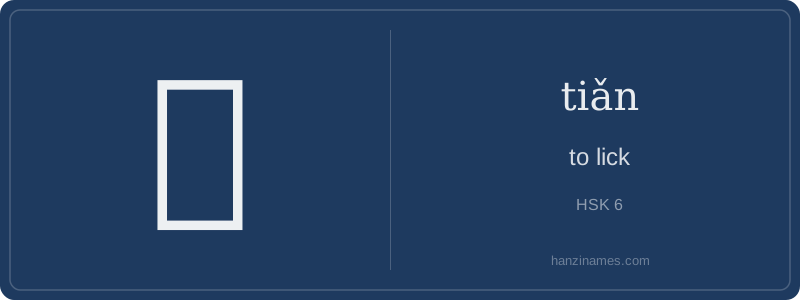
In modern Chinese, 舔 appears frequently in internet slang and colloquial speech, most notably in the derogatory term ‘舔狗’ (tiǎn gǒu), widely documented on platforms like Weibo and Zhihu since ~2017, describing someone excessively fawning over another, especially romantically. It also appears literally in food contexts (e.g., licking an ice cream cone) and medically in descriptions of wound-cleaning behavior in veterinary or traditional healing texts.
The character is not pictographic in origin — its earliest attestation is in seal script (c. 3rd c. BCE), where it combines the radical 舌 (tongue) with 天 (tiān, ‘heaven’) as a phonetic component. While 天 suggests pronunciation (both read tiān/tiǎn with tone shift), no ancient oracle-bone form survives. Today, Chinese learners encounter it most often in digital discourse — typing ‘舔’ in chat to mock performative devotion or, playfully, to express exaggerated fondness for food or pets.
At first glance, 舔 (tiǎn) — 'to lick' — seems purely physical: a tongue’s moist, instinctive motion. Yet in Chinese worldview, the tongue is not just an organ but a bridge between inner desire and outer expression. Classical texts associate 舌 with speech, discernment, and even moral sensitivity — hence the radical 舌 (tongue) anchoring this character signals that licking is never neutral; it conveys longing, submission, flattery, or care, depending on context and intent.
This duality reflects a broader cultural lens: actions are interpreted through relational ethics rather than isolated mechanics. To lick isn’t merely biological — it’s relational. A mother licks her newborn (a rare but documented folk reference in medical classics); a sycophant ‘licks the boots’ of power; a child licks an ice pop with unselfconscious joy. The meaning shifts with agency, hierarchy, and sincerity — revealing how Chinese semantics embed Confucian attention to role and motive.
Even linguistically, 舔 resists reduction. Unlike English ‘lick’, which can be literal or metaphorical (e.g., ‘lick into shape’), 舔’s metaphors are tightly bound to social evaluation: ‘舔狗’ (tiǎn gǒu, ‘lick-dog’) — a self-deprecating internet term for someone obsequiously pursuing affection — shows how bodily action becomes moral commentary. Thus, 舔 opens a window into how Chinese language encodes ethics in anatomy, turning the tongue into both instrument and indictment.
Example Sentences
Common Compounds
Similar Characters — Don't Mix These Up
Your First Step into Chinese Culture: Get a Chinese Name
Every journey into Chinese begins with a name. Use our free Chinese name generator to create a meaningful, personalized Chinese name that fits you perfectly.
Get My Chinese Name →