铺
Character Story & Explanation
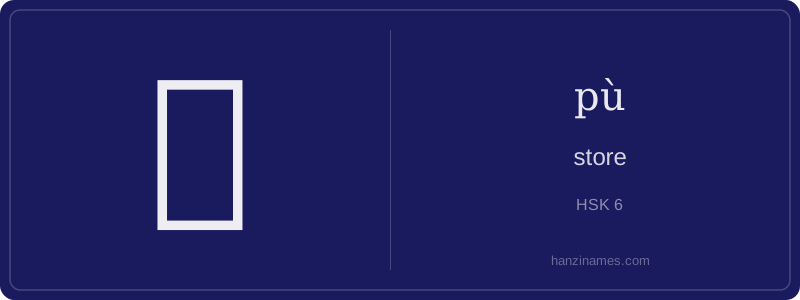
In daily life, 铺 (pù) appears ubiquitously on shop signs across China—especially in historic neighborhoods like Shanghai’s Tianzifang or Chengdu’s Kuanzhai Alley. Common compounds include 铺面 (pùmiàn, 'shopfront'), 铺货 (pùhuò, 'to stock shelves'), and the idiom 摆铺子 (bǎi pùzi, 'to set up shop,' often used figuratively for launching ventures). Historically, during the Ming and Qing dynasties, guild-regulated 铺 were licensed units for retail trade, documented in local gazetteers like the 1739 Shuntianfu Zhi.
The character’s form evolved from seal script, where 铺 combined 钅 (metal radical, indicating goods-related trade) and 圃 (pǔ, 'enclosed garden'—later simplified to 辅, suggesting support or establishment). It was never a pictograph but a phono-semantic compound: 钅 signals domain (commerce/metal goods), while 辅 (fǔ) provided sound approximation. No oracle bone or bronze inscriptions exist for 铺—it first appears reliably in Han dynasty texts as a commercial term.
Imagine walking down Beijing’s bustling Nanluoguxiang alley at dusk—the scent of roasted chestnuts and sesame oil hangs in the air as red lanterns glow above narrow shopfronts. One sign reads ‘老张布铺’ (Lǎo Zhāng Bù Pù), meaning 'Old Zhang’s Fabric Store.' Here, 铺 (pù) isn’t abstract—it’s the physical space where generations have sold bolts of silk, measured thread by hand, and haggled over prices across worn wooden counters. This character embodies commerce rooted in place, community, and continuity.
The radical 钅 (jīn, 'metal') hints at historical ties to metalworking shops—early 铺 often sold tools, nails, or hardware. Though modern usage extends to teahouses, pharmacies, and even internet cafés (网吧铺), the core idea remains: a small-scale, owner-operated commercial unit. Unlike large department stores (商场), a 铺 implies intimacy, specialization, and local identity—think ‘a corner bakery’ rather than ‘a supermarket chain.’
Crucially, 铺 has two pronunciations: pù (noun, 'store') and pū (verb, 'to spread/lower'). This duality reflects Chinese linguistic economy—same shape, distinct grammatical roles. In speech, context and tone prevent confusion: ‘开铺’ (kāi pù, 'open a store') vs. ‘铺床’ (pū chuáng, 'make the bed'). Mastering both reveals how deeply form and function intertwine in written Chinese.
Example Sentences
Common Compounds
Similar Characters — Don't Mix These Up
Your First Step into Chinese Culture: Get a Chinese Name
Every journey into Chinese begins with a name. Use our free Chinese name generator to create a meaningful, personalized Chinese name that fits you perfectly.
Get My Chinese Name →