艇
Character Story & Explanation
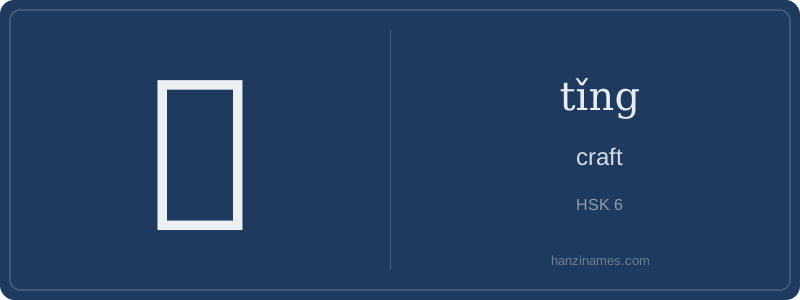
In contemporary Chinese, 艇 is rarely used alone; it appears almost exclusively in compound nouns denoting specific types of small or specialized watercraft — especially in formal, technical, or media contexts. You’ll hear it in news reports about 海警艇 (hǎijǐng tǐng, coast guard patrol boats), in sports coverage of 帆艇 (fān tǐng, sailing dinghies), and in military terminology like 潜艇 (qián tǐng, submarine). It’s absent from casual speech — people say 小船 (xiǎo chuán) for 'small boat', not 小艇 — reflecting its lexical specialization.
The character’s origin is well-documented: 舟 is a clear pictograph of a boat (甲骨文 oracle bone inscriptions show a hull with crossbeams). 廷, while originally meaning 'courtyard', functions here purely as a phonetic component. There’s no historical evidence linking 艇 to architecture — it’s a classic case of sound borrowing, not semantic blending.
As a linguistic detective, I begin at the scene: the radical 舟 (zhōu), meaning 'boat' — a pictograph of a simple vessel, appearing in oracle bone inscriptions over 3,000 years old. This radical anchors 艇 firmly in the maritime semantic field, signaling its core domain: watercraft. The right component, 廷 (tíng), originally depicted a courtyard or hall but here serves phonetically, approximating the pronunciation tǐng. Crucially, 廷 doesn’t contribute meaning — it’s a sound clue, not a semantic one.
The character first appears reliably in Han dynasty texts (206 BCE–220 CE), where it consistently denotes a small, swift, or specialized boat — distinct from larger vessels like 船 (chuán) or 艦 (jiàn). Its 12-stroke structure reflects classical standardization: six strokes for 舟, six for 廷. No bronze script variant survives, but clerical script forms show clear separation of the two components, confirming its compound nature rather than pictographic evolution.
Modern analysis confirms 艇 is a phono-semantic compound (xíngshēngzì): 舟 provides meaning (watercraft), 廷 provides sound (tǐng, though with historical phonetic drift — Middle Chinese *‘deng’ → modern tǐng). It never meant 'hall boat' or 'court craft'; that’s a folk etymology trap. The character’s stability across millennia — unchanged in form since the Kangxi Dictionary (1716) — testifies to its functional precision: naming compact, maneuverable boats used for patrol, sport, or transport.
Example Sentences
Common Compounds
Similar Characters — Don't Mix These Up
Your First Step into Chinese Culture: Get a Chinese Name
Every journey into Chinese begins with a name. Use our free Chinese name generator to create a meaningful, personalized Chinese name that fits you perfectly.
Get My Chinese Name →