荒
Character Story & Explanation
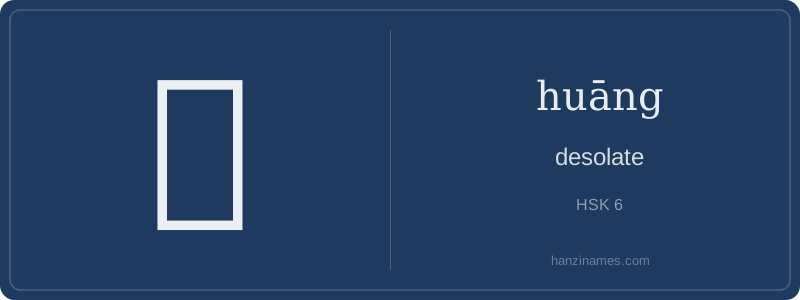
In daily Chinese, 荒 appears in high-frequency terms like 荒废 (huāngfèi, 'to neglect') and 开荒 (kāihuāng, 'to reclaim wasteland'), reflecting enduring agrarian concerns. Historically documented in the *Rites of Zhou*, '荒政十二' listed twelve state responses to famine—including tax remission and grain distribution. The idiom 荒诞不经 (huāngdàn bùjīng, 'preposterous') uses 荒 metaphorically for logical barrenness, attested since the Ming dynasty.
The character’s form derives from seal script: upper 艹 (grass) + lower 亡 (perish). No oracle bone form survives, but bronze inscriptions show early versions with grass over a simplified 'death' sign. Its modern shape stabilized by the Han, emphasizing vegetal absence—not dead plants, but land where vegetation *should* thrive but doesn’t.
As an archaeologist brushing dust from a Han dynasty bamboo slip, I find 荒 inscribed not as mere 'desolation', but as a landscape scarred by abandonment—fields left untended after war or famine. Its grass radical (艹) anchors it in the earth, while the phonetic component 亡 (wáng, 'to perish') whispers collapse. Early texts like the *Book of Songs* use it to describe wastelands where ritual millet once grew—less a static adjective, more a verb of erasure.
This character bears witness to ecological memory: during the Warring States period, states recorded '荒政' (huāngzhèng)—disaster relief policies for regions rendered barren by drought or locusts. The 9-stroke form we write today crystallized in clerical script, shedding earlier variants with more complex top components. Its structure is forensic: three grass strokes above, then a descending 'perish'—a visual chronicle of decay layered onto life.
In Tang poetry, 荒 becomes lyrical ruin: Wang Wei writes of '荒城临古渡' (a desolate city facing an ancient ferry), where the character evokes time’s sediment—not just emptiness, but palimpsest. Modern excavations at Dunhuang reveal Buddhist sutras warning against '心荒' (xīn huāng, 'a desolate heart'), proving its semantic reach extends beyond terrain into moral and spiritual topography. It is never neutral; it always implies loss that was once full.
Example Sentences
Common Compounds
Similar Characters — Don't Mix These Up
Your First Step into Chinese Culture: Get a Chinese Name
Every journey into Chinese begins with a name. Use our free Chinese name generator to create a meaningful, personalized Chinese name that fits you perfectly.
Get My Chinese Name →