葬
Character Story & Explanation
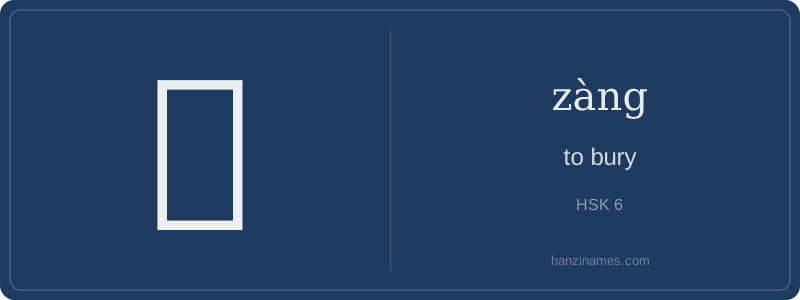
In modern Chinese, 葬 is primarily used in formal, literary, or ritual contexts—not casual speech. It appears in official documents (e.g., '遗体火化及安葬许可'), news reports on state funerals, and classical idioms like 入土为安 (rù tǔ wéi ān, 'peace comes when the body enters the earth'). It’s also central in Confucian mourning rites and legal terms such as 土葬 (tǔzàng, 'burial') versus 火葬 (huǒzàng, 'cremation'), both regulated under China’s 1985 Regulations on Funeral Management.
The character’s written form has no verified pictographic origin (no oracle bone form survives). Instead, its earliest attested form—on Warring States bamboo slips—shows 爪+死+廾, confirming the 'hands placing the dead' structure. Today, Chinese people most commonly encounter 葬 on cemetery signs, funeral notices, or historical dramas depicting imperial burials—always signaling solemnity, legality, and cultural continuity.
As a linguistic detective, I begin with the modern form of 葬: twelve strokes, grass radical (艹) atop 死 (sǐ, 'to die') and 廾 (gǒng, 'hands holding'). At first glance, it looks like 'grass over death and hands'—but this is not a pictograph of burial. In fact, the top isn’t just 艹; it’s a corrupted form of 爪 (zhuǎ, 'claw/hand'), which evolved into the grass-like shape through clerical script simplification. So what appears to be a plant radical is actually a fossilized hand gesture—a clue buried in plain sight.
The middle component 死 ('death') anchors the meaning unmistakably, while the bottom 廾 represents two hands lifting or placing something—likely referencing the ritual act of laying the body to rest. This tripartite structure (hand–death–hands) encodes intentionality: not just death, but the deliberate, ceremonial act of interment. Unlike characters for 'kill' or 'die', 葬 emphasizes human agency—the communal, solemn labor of burial, not the event itself.
Historically, 葬 first appears reliably in Warring States bamboo texts and early Han dynasty inscriptions—not oracle bones. Its form stabilized during the Qin standardization, where seal script already shows the recognizable three-part layout. The grass radical misconception persists in many textbooks, but paleography confirms: the top is 爪→→艹, a phonetic-semantic hybrid that shifted visually but retained its gestural meaning. This character doesn’t grow—it *lays down*.
Example Sentences
Common Compounds
Similar Characters — Don't Mix These Up
Your First Step into Chinese Culture: Get a Chinese Name
Every journey into Chinese begins with a name. Use our free Chinese name generator to create a meaningful, personalized Chinese name that fits you perfectly.
Get My Chinese Name →