荡
Character Story & Explanation
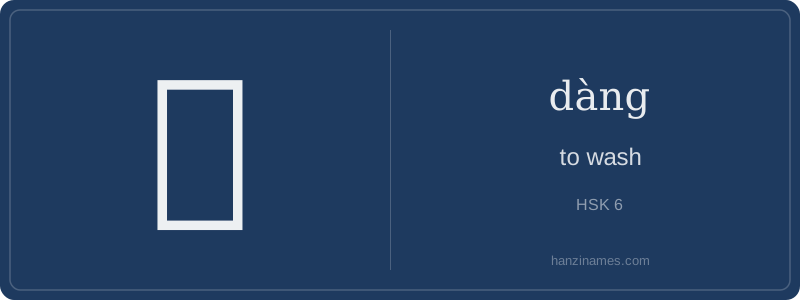
Historically, 荡 appears in classical texts like the Shuōwén Jiězì (121 CE), defined as 'to wash away' (涤荡), often in moral or political contexts — e.g., 'sweeping away corruption'. Today, it’s common in set phrases: 扫荡 (sǎo dàng, 'to sweep clean') describes military operations or digital virus removal; 荡涤 (dàng dí) appears in formal speeches about 'purifying social风气 (customs)'. The idiom 荡然无存 (dàng rán wú cún) — 'completely wiped out' — is widely used in news and literature.
The character’s form is not pictographic but phono-semantic: 艹 signals plant/nature-related concepts, while 昜 (yáng) provides sound and conveys 'rising, bright, expansive' — together suggesting 'a sweeping, open, cleansing motion', consistent with its documented usage since Han dynasty inscriptions and bamboo-slip texts.
Hi students! Let’s explore 荡 (dàng), a Level 6 HSK character with 9 strokes and the grass radical 艹. Though its basic dictionary meaning is 'to wash', don’t picture soap and water just yet — in modern Chinese, 荡 is rarely used alone for washing. Instead, it appears in compound words and idioms where it conveys motion, swaying, or sweeping away — like waves washing over rocks or emotions surging and clearing out.
This character carries poetic and dynamic energy. Think of it as ‘washing’ not with a sponge, but with movement: a swing, a ripple, a cleansing surge. Its radical 艹 (grass/plant) hints at natural, organic motion — like reeds swaying in water — while the right side 昜 (yáng, an ancient variant of ‘sun’ + ‘elevation’) suggests brightness and upward flow, reinforcing ideas of openness and release.
As you learn 荡, remember it’s more about *process* than *action*: it’s the rhythm of washing away, not the act itself. You’ll encounter it in literary expressions, idioms like 荡然无存 (utterly gone), and even tech terms like 扫荡 (sweeping cleanup). It’s advanced because it’s subtle — mastering it means understanding how Chinese uses physical motion to express abstract change.
Example Sentences
Common Compounds
Similar Characters — Don't Mix These Up
Your First Step into Chinese Culture: Get a Chinese Name
Every journey into Chinese begins with a name. Use our free Chinese name generator to create a meaningful, personalized Chinese name that fits you perfectly.
Get My Chinese Name →