薪
Character Story & Explanation
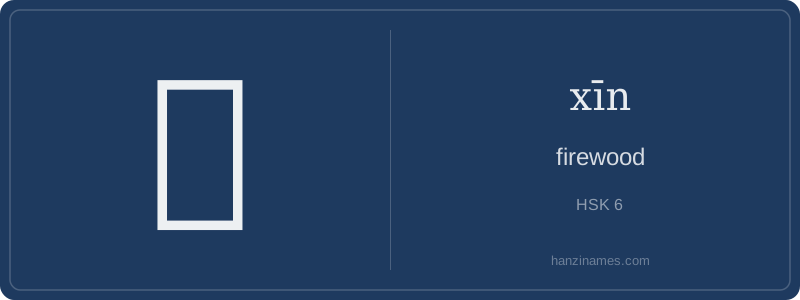
Historically, 薪 was a vital term in pre-modern China: tax records from the Tang and Song dynasties list 'firewood quotas' (薪炭税), and classical texts like the Book of Rites specify firewood (薪) as one of the 'five essentials' for household survival. Today, it’s rarely used standalone—but appears in fixed expressions like 抱薪救火 (a famous idiom from the Records of the Grand Historian) and in formal terms such as 薪资 (xīnzī, 'compensation').
The character is not pictographic; it evolved from seal script into its current form by the Han dynasty. The bottom 新 ('new') serves as both sound clue and conceptual link—firewood must be freshly gathered. In modern life, Chinese people encounter 薪 most often in written contexts: salary slips (薪水), HR documents, or news about wage reforms.
Hi students! Let’s explore 薪 (xīn), a Level 6 HSK character meaning 'firewood' or 'fuel'. Though it looks complex with 16 strokes, its structure is logical: the top is the grass radical 艹 (indicating plant origin), and the bottom is 新 (xīn, 'new')—a phonetic component that also subtly hints at renewal, since firewood is freshly cut fuel. This is a classic example of a phono-semantic compound.
Don’t confuse 薪 with other 'xīn' characters like 心 (heart) or 欣 (joy)—they share pronunciation but differ in meaning and writing. In ancient China, firewood was essential for cooking, heating, and ritual fires, so 薪 carried real economic weight. Even today, it appears in formal, literary, or metaphorical contexts—not daily casual speech, but in idioms, historical texts, and modern compound words.
As you practice writing, remember the stroke order: start with the grass radical (three short strokes), then write the bottom part 新 step by step—left to right, top to bottom. Writing it slowly helps build muscle memory. While you won’t use 薪 alone in conversation, recognizing it unlocks deeper vocabulary like 薪水 (salary) and 成语 like 抱薪救火 (carrying firewood to put out a fire—i.e., making a problem worse).
Example Sentences
Common Compounds
Similar Characters — Don't Mix These Up
Your First Step into Chinese Culture: Get a Chinese Name
Every journey into Chinese begins with a name. Use our free Chinese name generator to create a meaningful, personalized Chinese name that fits you perfectly.
Get My Chinese Name →