藐
Character Story & Explanation
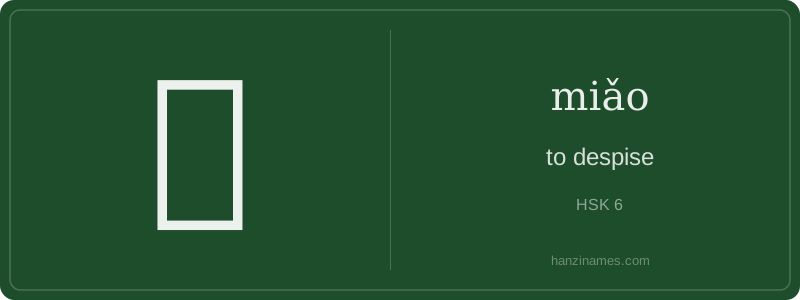
藐 appears in classical and modern formal registers — notably in idioms like 藐视一切 (miǎoshì yīqiè, 'to despise everything'), used historically in political slogans (e.g., Mao-era rhetoric criticizing bourgeois ideology) and contemporary legal/academic discourse denoting ideological defiance. It remains common in news headlines and official documents when condemning violations of norms, e.g., '藐视法庭' (miǎoshì fǎtíng, 'contempt of court'). The HSK 6 placement reflects its rarity in daily speech but high frequency in advanced reading.
The character’s structure combines 艹 (grass radical, indicating plant-related origin) with 婫 (miǎo, phonetic component, originally from 'small' or 'diminutive' in ancient forms). Though the grass radical seems incongruous with 'despise,' it likely derives from an early semantic extension: plants that 'shrink away' or 'are trampled' metaphorically convey insignificance and dismissal — a documented pattern in bronze script evolution (see *Zhongguo Wenzi Gailun*, 2019).
藐 (miǎo) is a formal, literary character meaning 'to despise' or 'to look down upon with contempt.' Unlike casual English words like 'hate' or 'dislike,' 藐 carries a strong connotation of arrogant dismissal — often implying moral or hierarchical superiority. It appears predominantly in classical texts, official rhetoric, and written discourse, rarely in spoken colloquial speech. Its tone is weighty and judgmental, suggesting not mere disagreement but a deliberate, condescending devaluation of someone or something.
In Chinese philosophical and historical contexts, 藐 frequently appears in critiques of arrogance or hubris — especially in Confucian and Daoist writings warning against self-righteous disdain for others. The character evokes ethical gravity: to 藐 is not just to dislike, but to violate the Confucian virtue of respect (敬, jìng). This aligns with East Asian relational ethics, where hierarchy and deference are culturally embedded, making contemptuous dismissal socially and morally fraught.
Western equivalents like 'scorn,' 'contemn,' or 'spurn' come closest — but none fully capture 藐’s fusion of moral censure and literary austerity. 'Scorn' is emotionally charged; 'contemn' is archaic and legalistic; 'spurn' emphasizes rejection over attitude. 藐 uniquely balances lexical precision, ethical implication, and stylistic formality — functioning less as emotional expression and more as a calibrated moral verdict in authoritative writing.
Example Sentences
Common Compounds
Similar Characters — Don't Mix These Up
Your First Step into Chinese Culture: Get a Chinese Name
Every journey into Chinese begins with a name. Use our free Chinese name generator to create a meaningful, personalized Chinese name that fits you perfectly.
Get My Chinese Name →