蚀
Character Story & Explanation
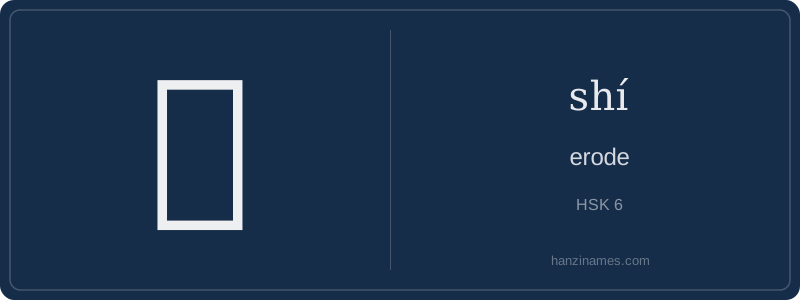
Today, 蚀 appears most frequently in scientific and financial contexts: lunar eclipses (月蚀), chemical corrosion (腐蚀), and economic erosion (通货膨胀对购买力的侵蚀). It’s central to the idiom 日削月蚀 (rì xuē yuè shí)—‘daily paring, monthly nibbling’—describing gradual decline, cited in the 2nd-century BCE Hanshu to describe territorial loss. Modern media uses it metaphorically: ‘reputation erosion’ (声誉被侵蚀) is a common collocation in business journalism.
The character’s form is well-documented: 饣 (food radical, simplified from 食) + 虫 (insect). No oracle-bone or bronze script forms survive, but its earliest attestation is in Warring States bamboo texts (c. 4th century BCE), where it consistently conveys slow, consumptive loss—never sudden destruction.
As an archaeologist brushing dust from a Han dynasty bamboo slip, I find 蚀 etched not as a celestial omen—but as a quiet, relentless force. Its left side 饣 (food radical) hints at consumption: something eaten away, grain by grain, like rust on bronze or time on stone. This isn’t violent destruction—it’s patient erosion, the kind that leaves hollows in ancient temple eaves or fades ink on steles. The right side 虫 (insect) reinforces this: tiny agents, invisible until damage accumulates.
Excavating Tang poetry manuscripts, I note 蚀 appears in astronomical records—not as ‘eclipse’ per se, but as ‘the sun being nibbled’: 月蚀 (yuèshí), ‘moon nibbled,’ later standardized as ‘lunar eclipse.’ Here, the character preserves pre-scientific cosmology: celestial bodies weren’t obscured—they were *consumed*, then regurgitated. This embodied metaphor persisted for over 1,500 years, revealing how language fossilizes worldview.
At a Ming-dynasty tomb site, corrosion on iron hinges matched inscriptions describing metal ‘being eaten by dampness’—a literal use of 蚀. Unlike modern technical terms like 腐蚀 (fǔshí, ‘corrosion’), classical usage emphasized agency: the dampness *acts*, the metal *suffers*. This animistic nuance survives in HSK 6 vocabulary: 蚀 is never passive—it implies ongoing, often insidious, diminishment: of wealth, reputation, or light itself.
Example Sentences
Common Compounds
Similar Characters — Don't Mix These Up
Your First Step into Chinese Culture: Get a Chinese Name
Every journey into Chinese begins with a name. Use our free Chinese name generator to create a meaningful, personalized Chinese name that fits you perfectly.
Get My Chinese Name →