融
Character Story & Explanation
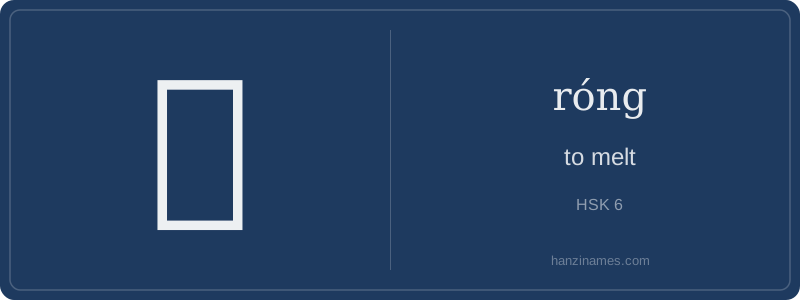
融 is widely used in formal and technical contexts: in finance ('financial integration'), policy ('ethnic unity and cultural integration'), and science ('fusion energy'). It appears in official documents, news headlines (e.g., '京津冀协同发展,推动区域融合发展'), and idioms like 水乳交融 (shuǐ rǔ jiāo róng, 'like water and milk blending seamlessly' — signifying perfect harmony). The term 融资 (róngzī, 'fundraising') is ubiquitous in business and startup ecosystems across China.
The character’s written form has no verified pictographic origin; 鬲 is a real ancient bronze cauldron, but its use in 融 is primarily phonetic-semantic scaffolding—not depiction. Today, Chinese learners encounter 融 most often in compound words like 融合 (rónghé, 'to integrate') or 融化 (rónghuà, 'to melt'), especially in HSK 6 reading passages on globalization or environmental science.
As a linguistic detective, I begin with the modern form of 融: 16 strokes, radical 鬲 (a rare ancient cooking vessel), and phonetic component 虫 (though phonetically unrelated today—this reflects historical sound shifts). The character’s structure suggests an archaic semantic-phonetic compound, where 鬲 may hint at heat-related transformation—fitting for 'melting'.
Tracing backward, 融 does not appear in oracle bone or bronze inscriptions. Its earliest confirmed forms emerge in Warring States bamboo texts and Han dynasty seal script, consistently combining 鬲 with elements like 虫 or ⺈. Crucially, it was never a pictograph of melting ice—it evolved as a phonosemantic character, with meaning anchored by usage, not visual mimicry.
The phonetic component shifted over millennia: from Middle Chinese /jyŋ/ to modern róng, while its core semantic field expanded metaphorically—from physical melting (ice, metal) to abstract fusion (cultures, ideas, markets). This semantic broadening mirrors how Chinese characters often acquire layered meanings through classical texts and bureaucratic language, especially during the Tang–Song scholarly revival.
Example Sentences
Common Compounds
Similar Characters — Don't Mix These Up
Your First Step into Chinese Culture: Get a Chinese Name
Every journey into Chinese begins with a name. Use our free Chinese name generator to create a meaningful, personalized Chinese name that fits you perfectly.
Get My Chinese Name →