蚁
Character Story & Explanation
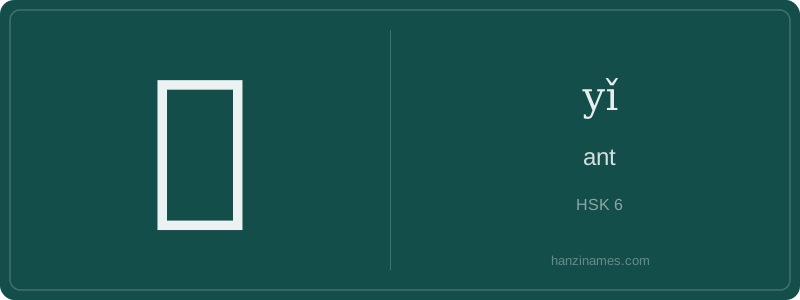
In modern Chinese, 蚁 most commonly appears in compound words denoting scale, fragility, or collective behavior—especially in scientific, economic, and literary contexts. It features in the widely taught idiom 蚁穴溃堤 (yǐ xué kuì dī), meaning 'an ant’s nest can breach a dyke', illustrating how small flaws cause systemic collapse—a phrase cited in official media and textbooks since the 1950s. The character also appears in technical terms like 蚁酸 (yǐ suān, formic acid) and colloquial expressions like 蚂蚁搬家 (mǎyǐ bānjiā, 'ants moving house'), used to describe slow, laborious group efforts.
The character’s form is not pictographic—it evolved from seal script where 虫 (insect) was clearly distinguishable on the left, and 义 served as a standardized phonetic loan. No oracle bone or bronze inscriptions contain 蚁; it first appears reliably in Warring States bamboo slips (4th c. BCE), confirming its origin as a later, scholarly coinage for precise entomological reference.
Unearthing this character feels like brushing dust from a Han dynasty lacquer box—there, beneath layers of calligraphic evolution, lies 蚁: a meticulous nine-stroke record of human observation. Its left side, 虫 (chóng), is the ‘insect’ radical—a taxonomic anchor used since the Shuōwén Jiězì (121 CE) to classify arthropods. This isn’t poetic metaphor; it’s systematic zoological categorization inscribed into script over two millennia ago.
The right component, 义 (yì), serves phonetically—not semantically. Though 义 means 'righteousness', here it’s purely a sound clue, approximating the ancient pronunciation *ŋrəʔ (reconstructed Old Chinese). This phonosemantic structure reveals how early scribes prioritized audibility without compromising biological classification: an ant is first and foremost a *bug*, then a *sound*.
What’s striking is its stability: unlike many characters reshaped by dynastic reforms, 蚁 appears virtually unchanged in Tang steles, Song printed texts, and Ming medical manuscripts. Its consistency suggests ants were not curiosities but constants—pests in granaries, subjects in herbal remedies (e.g., ant-based tonics in *Bencao Gangmu*), and metaphors for collective labor long before ‘hive mind’ entered English lexicon.
Example Sentences
Common Compounds
Similar Characters — Don't Mix These Up
Your First Step into Chinese Culture: Get a Chinese Name
Every journey into Chinese begins with a name. Use our free Chinese name generator to create a meaningful, personalized Chinese name that fits you perfectly.
Get My Chinese Name →