蜡
Character Story & Explanation
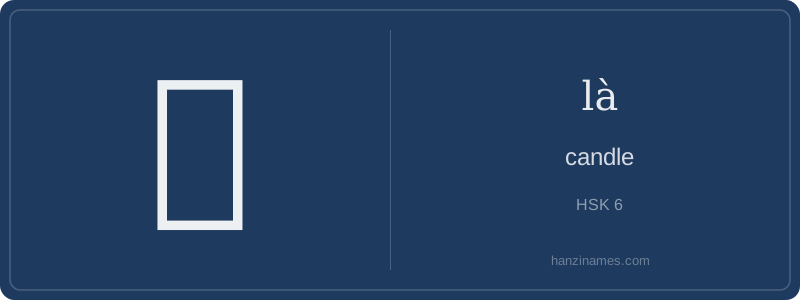
蜡 has been documented since the Han Dynasty (206 BCE–220 CE) in texts like the *Shuowen Jiezi* (100 CE), defined as 'insect-derived grease'—confirming its ancient association with beeswax. It appears in Tang-era poetry describing temple candles and Ming-Qing records of candle taxation. Today, it’s ubiquitous in phrases like 蜡烛 (làzhú, 'candle') and 蜡笔 (làbǐ, 'crayon'), and in idioms like 抱薪救火,无异于抱蜡救火 (a variant allusion meaning 'futile effort', referencing wax’s flammability).
The character is not pictographic but phono-semantic: the left side 虫 (chóng, 'insect') is the semantic radical indicating biological origin; the right side 昔 (xī, 'past') serves as the phonetic component—though pronunciation shifted from xī to là over time due to historical sound changes. This reflects standard character evolution in Middle Chinese, not oracle-bone invention.
The Chinese character 蜡 (là) primarily means 'candle' but also refers to 'wax' as a material—highlighting its dual semantic role. Unlike English, where 'candle' and 'wax' are distinct nouns, Chinese uses the same character for both the object and its substance, reflecting a conceptual link between form and material. This unity is common in Classical Chinese, where context determines meaning—e.g., 蜡烛 (làzhú) explicitly means 'candle', while 工业蜡 (gōngyè là) means 'industrial wax'.
Historically, beeswax candles were luxury items in imperial China, used in temples and elite households for rituals and lighting. The character’s insect radical (虫) signals its organic origin—beeswax being insect-derived—unlike paraffin (a petroleum product), which entered China only in the 20th century. This etymological grounding underscores traditional ecological awareness: linking material source to lexical form.
In modern usage, 蜡 extends metaphorically: 蜡像 (làxiàng, 'wax figure') evokes lifelike stillness, while 蜡黄 (làhuáng, 'waxy yellow') describes a sickly pallor—borrowing wax’s visual qualities of dullness and translucence. Western equivalents like 'candle' lack this built-in material reference; English requires separate terms ('beeswax', 'paraffin'), whereas 蜡 inherently carries its origin story in its structure and radical.
Example Sentences
Common Compounds
Similar Characters — Don't Mix These Up
Your First Step into Chinese Culture: Get a Chinese Name
Every journey into Chinese begins with a name. Use our free Chinese name generator to create a meaningful, personalized Chinese name that fits you perfectly.
Get My Chinese Name →