弟
Character Story & Explanation
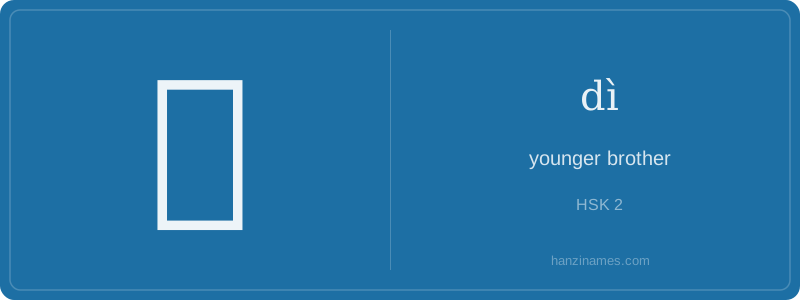
弟 is widely used in daily speech and formal contexts to denote 'younger brother', especially in family introductions, official documents (e.g., household registration), and respectful address (e.g., older colleagues may call junior male coworkers 小弟 xiǎo dì). Common idioms include 兄弟同心,其利断金 (xiōng dì tóng xīn, qí lì duàn jīn)—'When brothers unite, their strength can sever metal'—highlighting solidarity. Historically, it appears in early texts like the Analects (Lunyu) and Mencius, consistently referencing fraternal ethics.
The character’s form evolved from seal script; its modern shape retains no pictographic sun/moon/tree origin. The top component (丷) and middle (弓) derive from ancient phonetic-semantic compounds, not visual depictions. Today, Chinese people commonly use 弟 in digital communication—e.g., WeChat group names like ‘三兄弟群’ (Sān Xiōng Dì Qún, 'Three Brothers Group')—reinforcing its living, social function.
The character 弟 (dì) embodies Confucian ideals of familial hierarchy and moral responsibility. In traditional Chinese society, the 'younger brother' was expected not only to respect his elder siblings but also to cultivate humility, diligence, and loyalty—qualities encoded in the very structure of the character. Its radical 弓 (bow) historically signals discipline and readiness, evoking the martial and ethical training expected of younger male kin in classical education.
Unlike Western individualism, Chinese kinship terms like 弟 encode relational position—not just biology, but duty. Calling someone 弟—even outside blood ties—signals affectionate seniority, mentorship, or gentle authority. This linguistic practice reflects a worldview where identity is co-constructed through role-based relationships, and respect flows both upward (to elders) and downward (in guidance to juniors).
Importantly, 弟 is never neutral: it implies an elder counterpart (兄 xiōng), reinforcing interdependence. This duality mirrors broader Chinese philosophical concepts like yin-yang—where meaning arises from contrast and balance. Thus, learning 弟 opens a door not to vocabulary alone, but to understanding how language shapes—and is shaped by—a society that values harmony, reciprocity, and contextual belonging.
Example Sentences
Common Compounds
Similar Characters — Don't Mix These Up
Your First Step into Chinese Culture: Get a Chinese Name
Every journey into Chinese begins with a name. Use our free Chinese name generator to create a meaningful, personalized Chinese name that fits you perfectly.
Get My Chinese Name →