蛮
Character Story & Explanation
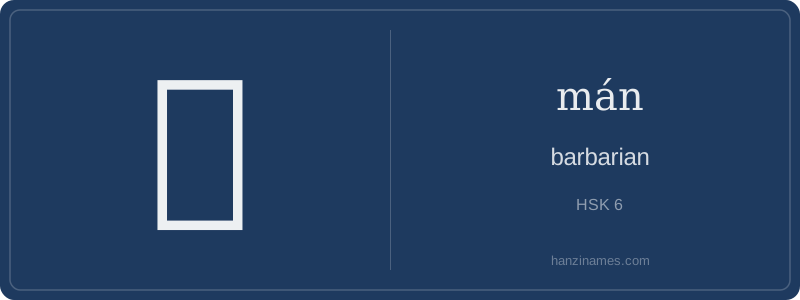
In modern Chinese, 蛮 is rarely used ethnically; instead, it appears almost exclusively as an adverb meaning 'rather', 'quite', or 'unreasonably', especially in colloquial speech and internet slang (e.g., 蛮好, 蛮厉害). It features in the classical idiom 蛮横 (mánhèng)—'brutally arbitrary'—still common in legal and journalistic contexts to describe abusive authority. Historically, it named the ‘Southern Man’ tribes in texts like the *Book of Rites*, later absorbed into Han identity.
The character’s structure combines 虫 (insect, radical) and 䜌 (luán, phonetic and semantic component meaning ‘tangled’ or ‘complex’). No oracle bone or bronze script form survives—the earliest attested form is in Warring States bamboo manuscripts. Today, Chinese speakers most commonly encounter it in phrases like ‘蛮有意思’ (‘quite interesting’) during casual conversation, signaling nuanced emphasis without negative intent.
As an archaeologist sifting through Han dynasty bamboo slips and Tang stele inscriptions, I find 蛮 not as a crude ethnic slur but as a layered cultural artifact—its ‘insect’ radical (虫) reflecting ancient Sino-centrism: non-Huaxia peoples were metaphorically ‘creeping’ beyond ritual boundaries, like insects outside the cultivated realm. This wasn’t biological racism but a cosmological distinction—civilization (wen 文) versus wildness (wu 武), mapped onto geography and comportment.
The character’s earliest secure attestations appear in the *Zuo Zhuan* (c. 4th century BCE), where ‘Man’ (蛮) names southern polities like the Chu-aligned Baiyue tribes—not as monolithic ‘barbarians’, but as politically autonomous groups engaged in tribute, intermarriage, and warfare with Zhou states. The ‘12-stroke’ form stabilized by the Han, its top component ‘䜌’ (luán) denoting entanglement or complexity, subtly encoding perceived cultural opacity to Central Plain scribes.
By the Song dynasty, 蛮 had undergone semantic softening: poets used it affectionately (e.g., ‘蛮腰’—‘barbarian waist’—to praise slender, graceful figures), while Neo-Confucians debated whether ‘man’ customs could be morally refined. Its persistence in modern Mandarin reveals how lexical fossils preserve historical hierarchies—even as the term now functions largely adjectivally, stripped of its original geopolitical weight yet retaining connotations of stubbornness, raw energy, or charming uncouthness.
Example Sentences
Common Compounds
Similar Characters — Don't Mix These Up
Your First Step into Chinese Culture: Get a Chinese Name
Every journey into Chinese begins with a name. Use our free Chinese name generator to create a meaningful, personalized Chinese name that fits you perfectly.
Get My Chinese Name →