衍
Character Story & Explanation
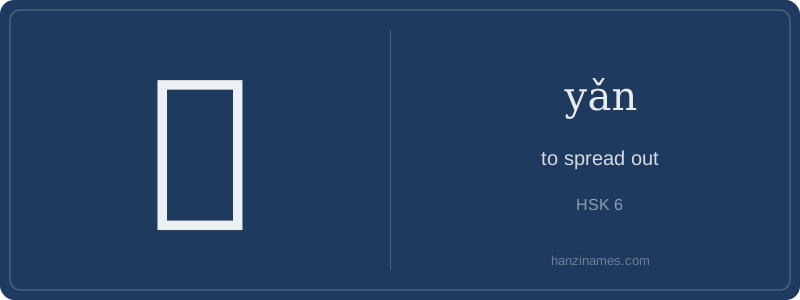
衍 is widely used in formal, academic, and technical contexts—especially in biology (e.g., 衍生物 yǎnshēngwù, 'derivative'), mathematics (e.g., 衍生矩阵 yǎnshēng jǔzhèn, 'derived matrix'), and policy documents (e.g., 衍生风险 yǎnshēng fēngxiǎn, 'secondary risk'). It appears in the Classical text *Zuo Zhuan* (c. 4th century BCE) describing ritual extensions: '礼之衍也' ('the spreading-out of ritual propriety'). The idiom 衍宗立派 (yǎn zōng lì pài) refers to founding new schools of thought by extending existing ones—a hallmark of Neo-Confucian development.
Historically, 衍 evolved from seal script (c. 3rd century BCE), where its left side clearly shows the 行 radical (two intersecting paths), and the right side combines 亍 (a variant of 行 meaning 'to halt and proceed') with 氵 (water radical)—suggesting movement that flows and spreads. No oracle bone form survives, but its standardized small-seal shape confirms its association with orderly propagation, not random dispersion.
The character 衍 (yǎn) embodies a quietly expansive worldview—one where growth is not abrupt or forceful, but organic, layered, and inevitable. Rooted in the 行 (háng/xíng) radical—signifying movement, travel, or conduct—it suggests spreading *through action*, like water seeping through soil or ideas rippling across generations. This reflects a classical Chinese understanding of change: not as rupture, but as gentle, continuous unfolding.
In Daoist and Confucian thought, ‘spreading out’ implies natural proliferation—of virtue, knowledge, or lineage—without coercion. 衍 appears in terms like 衍生 (yǎnshēng, 'to derive') and 衍变 (yǎnbiàn, 'evolutionary change'), revealing how Chinese philosophy values transformation that preserves continuity. It’s less about conquest and more about resonance: one idea giving rise to many, like branches from a single trunk.
Unlike Western metaphors of linear progress or explosive innovation, 衍 evokes lateral, contextual expansion—think of calligraphy ink bleeding subtly into paper, or ancestral rites broadening into community festivals. Its nine-stroke form balances structure (the 行 frame) with fluidity (the 亍 + 氵-like component), mirroring the cultural ideal of order enabling, not constraining, growth. To master 衍 is to grasp how Chinese thought sees influence—not as imposition, but as quiet, pervasive diffusion.
Example Sentences
Common Compounds
Similar Characters — Don't Mix These Up
Your First Step into Chinese Culture: Get a Chinese Name
Every journey into Chinese begins with a name. Use our free Chinese name generator to create a meaningful, personalized Chinese name that fits you perfectly.
Get My Chinese Name →