衰
Character Story & Explanation
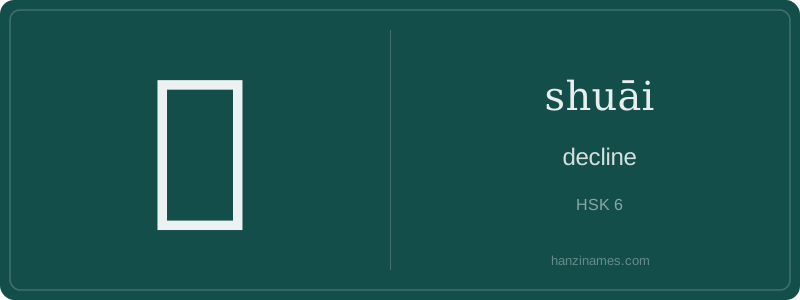
衰 is widely used in modern Standard Chinese to describe measurable decline — especially in economics, demographics, and health. It appears in official terms like 经济衰退 (jīngjì shuāituì, 'economic recession'), a phrase regularly used by China’s National Bureau of Statistics and media outlets such as Xinhua News Agency. The idiom 日薄西山,气息奄奄,人命危浅,朝不虑夕 (rì bó xīshān…), from the Jin Dynasty text 'Memorial on Behalf of Li Mi', uses 衰 indirectly through related imagery of waning light and failing breath — reinforcing its classical association with irreversible decline.
The character’s seal script form (c. 3rd century BCE) shows a head with disordered hair () above 衣, suggesting 'a person weakened to the point of disarray'. While the exact origin remains debated among scholars, this visual motif of physical debilitation is consistently documented in bronze inscriptions and early dictionaries like the Shuōwén Jiězì (121 CE), which defines it as 'declining, weakening, losing strength'.
Hi students! Let’s learn 衰 (shuāi), a Level 6 HSK character meaning 'to decay', 'to decline', or 'to wane'. Though it looks simple, it carries strong connotations of natural, often inevitable deterioration — like autumn leaves falling or energy fading. It’s not just physical decay; it describes weakening influence, fading popularity, or diminishing strength. Pronounced with the first tone (shuāi), it’s crucial for advanced vocabulary and formal writing.
This character belongs to the 衣 (yī, 'clothing') radical — but don’t be misled! Its connection to clothing is historical, not literal: in ancient script forms, the top part resembled a disheveled head of hair, and the bottom was a simplified ‘clothing’ component used phonetically. Over time, it evolved into today’s shape, keeping the radical for classification, not meaning.
Unlike everyday verbs like 坏 (huài, 'to break'), 衰 conveys a gradual, systemic decline — think empires, trends, or health over time. It appears frequently in literature, news analysis, and idioms. Because it’s formal and slightly literary, you’ll rarely hear it in casual speech, but you’ll see it in headlines like '经济衰退' (economic recession) or essays on cultural shifts. Mastering it helps you read sophisticated Chinese with nuance.
Example Sentences
Common Compounds
Similar Characters — Don't Mix These Up
Your First Step into Chinese Culture: Get a Chinese Name
Every journey into Chinese begins with a name. Use our free Chinese name generator to create a meaningful, personalized Chinese name that fits you perfectly.
Get My Chinese Name →