衷
Character Story & Explanation
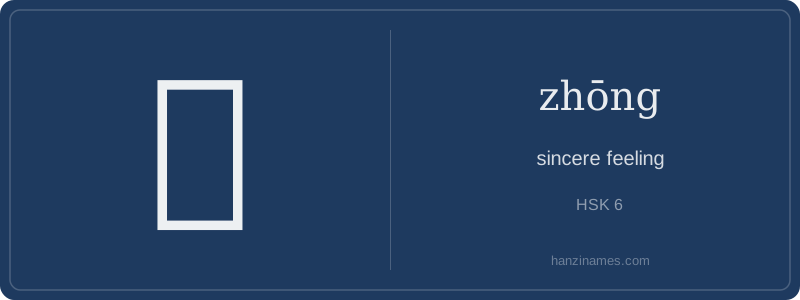
衷 appears primarily in formal, literary, or idiomatic usage—not in daily conversational speech. It features prominently in classical-derived phrases like 由衷 (yóu zhōng, 'from the bottom of one’s heart') and 真心实意 (zhēn xīn shí yì), where 衷 implies authenticity rooted in bodily sincerity. Historically, it appears in Tang and Song dynasty letters and official documents to denote genuine intent, especially in diplomatic or moral contexts.
The character’s structure is not pictographic but semantic-phonetic: the radical 衣 (clothing) indicates the domain (the inner self, as concealed beneath garments), while 中 (zhōng, 'middle') serves both phonetic and semantic roles—suggesting centrality, authenticity, and internal orientation. No oracle bone or bronze inscriptions contain 衷; it first appears reliably in Warring States bamboo texts.
As an archaeologist brushing dust from a Han dynasty bamboo slip, I uncover 衷 not as a static glyph but as a layered artifact of embodied cognition. Its structure—'clothing' (衣) enclosing 'middle' (中)—reveals an ancient physiological metaphor: the chest beneath garments, where emotions were believed to reside. This isn’t abstract philosophy; it’s anatomical literacy encoded in script—where inner life was literally *worn close*, protected yet palpable.
The character’s ten-stroke form crystallized during the Qin standardization, shedding earlier seal-script variants that emphasized heart-shaped contours. Unlike 心 (xīn, 'heart'), which denotes the organ or cognitive center, 衷 anchors feeling in somatic integrity—the quiet certainty of gut truth, not fleeting passion. Its radical衣 signals containment and intimacy, suggesting sincerity arises not from outward display but from what remains shielded, unperformed, and deeply personal.
In excavated Western Han texts like the Mawangdui medical manuscripts, 衷 appears in diagnostic contexts describing 'inner qi disturbance'—a physiological correlate of emotional unrest. This bridges ritual, medicine, and ethics: to speak with 衷 is to speak from the body’s core, where intention and physiology converge. Thus, 衷 is less ‘feeling’ than *embodied conviction*—a concept so culturally dense that modern Mandarin preserves it almost exclusively in fixed, high-register expressions, never in casual chatter.
Example Sentences
Common Compounds
Similar Characters — Don't Mix These Up
Your First Step into Chinese Culture: Get a Chinese Name
Every journey into Chinese begins with a name. Use our free Chinese name generator to create a meaningful, personalized Chinese name that fits you perfectly.
Get My Chinese Name →