裂
Character Story & Explanation
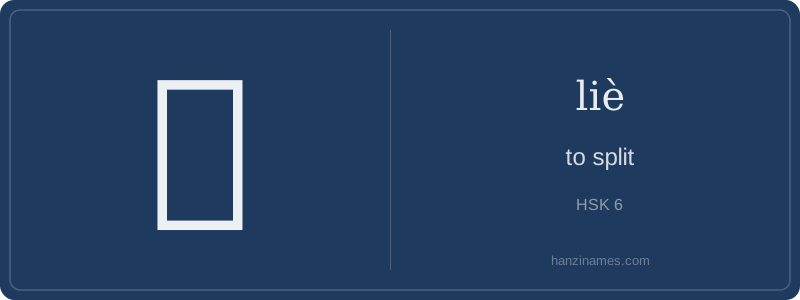
In daily Chinese, 裂 most commonly appears in compound words like 龟裂 (guīliè, 'crazing' or 'polygonal cracking') describing dried earth or aging skin, and in technical contexts such as 地裂 (dìliè, 'ground fissure') during seismic reports. It’s central to the idiom 山崩地裂 (shān bēng dì liè, 'mountains collapse and earth splits'), used since the Song dynasty in historical chronicles to depict catastrophic upheaval—not mythically, but in verified accounts of the 1556 Shaanxi earthquake.
The character’s form evolved from seal script, where the right side 列 clearly depicted 'arranged objects', reinforcing the idea of division into distinct, countable segments. While no oracle bone form survives, bronze inscriptions from the late Zhou show 裂 used in land demarcation texts—confirming its early association with precise, legally sanctioned splitting.
As an archaeologist brushing dust from a Han dynasty bamboo slip, I find 裂 etched not as a violent rupture—but as a controlled, almost ritualistic separation. Its radical 衣 (clothing) hints at early usage: fabric tearing under tension, a tangible, observable phenomenon documented in textile records from Mawangdui tombs. This wasn’t abstract division—it was the audible *rrrrip* of hemp cloth yielding to stress, a sensory anchor for meaning.
The twelve strokes reveal deliberate craftsmanship: the left side 衤 (variant of 衣) grounds it in material culture, while the right side 列—originally depicting aligned troops or arranged objects—suggests *ordered separation*, not chaos. In excavated legal texts from Zhangjiashan, 裂 appears in statutes about land partition, where boundaries were ‘split’ with surveyor’s precision, reflecting Confucian ideals of measured change.
By the Tang dynasty, scribes refined its form into today’s standard, yet preserved semantic duality: physical cleavage (a cracked jade bi disc) and metaphorical fracture (a broken alliance). Unlike 破 (to break, implying destruction), 裂 retains structural integrity—even after splitting, both parts remain recognizable. This nuance survives in modern usage: a ‘crack’ implies continuity; a ‘break’ implies termination.
Example Sentences
Common Compounds
Similar Characters — Don't Mix These Up
Your First Step into Chinese Culture: Get a Chinese Name
Every journey into Chinese begins with a name. Use our free Chinese name generator to create a meaningful, personalized Chinese name that fits you perfectly.
Get My Chinese Name →