裳
Character Story & Explanation
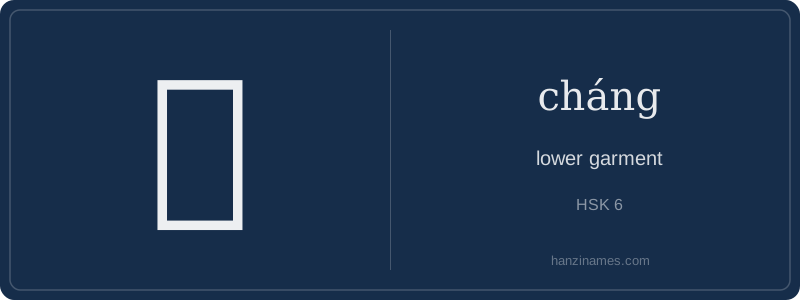
裳 appears almost exclusively in literary and historical contexts today. It’s preserved in the famous Tang dynasty poem line '霓裳羽衣曲' (Ní Cháng Yǔ Yī Qǔ) — the 'Rainbow Skirt and Feathered Robe Dance', a legendary imperial court performance. Modern usage is rare outside poetry, calligraphy, or historical dramas. You’ll also find it in the compound 衣裳 (yīshang), meaning 'clothes' — though here 裳 is pronounced shang (light tone), not cháng, showing phonetic evolution in spoken language.
The character’s form dates to seal script (c. 3rd century BCE): it clearly combines 衣 (clothing) on the right and 尚 (shàng, 'esteem, high') on the left — indicating garments of ceremonial importance. No oracle bone form survives, but bronze inscriptions confirm its use for ritual attire by the Warring States period. Today, Chinese learners meet it mainly in HSK 6 reading passages about classical culture.
Hi students! Let’s learn 裳 (cháng), a beautiful but rarely used character today. It means 'lower garment' — like ancient skirts or robes worn below the waist. Though you won’t see it in daily texting or shopping, it appears in classical poetry, historical texts, and formal literary expressions. Its pronunciation cháng is distinct from the more common shang (as in 衣裳 yīshang, where it's read lightly as 'shang'). Think of it as a poetic cousin of 衣 (yī, 'clothing') — together they form the compound for 'clothes' in classical Chinese.
The radical 衣 (yī, 'clothing') tells us this character belongs to the clothing family — just like 衫 (shān, 'shirt'), 袍 (páo, 'robe'), and 裤 (kù, 'trousers'). Notice how 衣 wraps around the right side of 裳? That’s a classic 'enclosing radical' pattern. The left part, 尚 (shàng), originally meant 'to esteem' or 'high', hinting at ceremonial or elevated dress — fitting for formal ancient attire.
Don’t confuse 裳 with modern words like 裙 (qún, 'skirt') or 裤 (kù, 'pants'). While those describe specific garments, 裳 is archaic and collective — referring broadly to draped lower-body wear in pre-Qin and Han dynasty contexts. You’ll encounter it mostly in fixed phrases like ‘霓裳’ (ní cháng, 'rainbow-colored robe') or in idioms evoking elegance and antiquity. Mastery of 裳 helps deepen your appreciation of classical Chinese literature — not just vocabulary, but cultural texture.
Example Sentences
Common Compounds
Similar Characters — Don't Mix These Up
Your First Step into Chinese Culture: Get a Chinese Name
Every journey into Chinese begins with a name. Use our free Chinese name generator to create a meaningful, personalized Chinese name that fits you perfectly.
Get My Chinese Name →