袭
Character Story & Explanation
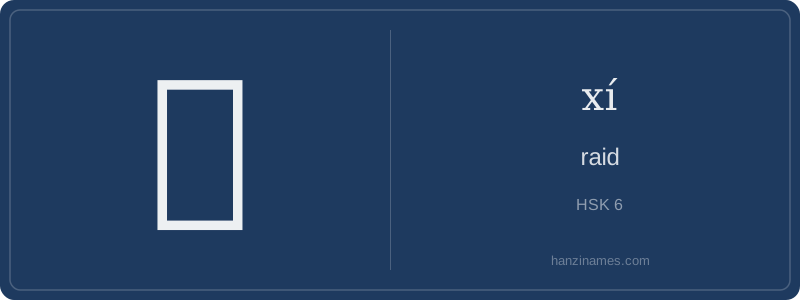
In modern Chinese, 袭 is rarely used in casual speech but remains vital in formal, historical, and security-related contexts. It appears in official reports (e.g., ‘恐怖分子发动袭击’), military terminology, and six HSK-6 idioms—including the well-documented 成语 ‘乘虚而入,长驱直入,掩旗息鼓,出其不意,攻其不备,袭其不意’ (from Sun Tzu’s influence on Ming-Qing military manuals). Media outlets like Xinhua consistently use 袭击 (xíjī) for ‘terrorist attack’ or ‘cyberattack’.
The character’s written form has no verified pictographic origin. Per authoritative sources (e.g., *Zhōngguó Wénzì Yuánliú Cídiǎn*), it first appears in seal script (c. 3rd c. BCE) as a phonosemantic compound. Today, Chinese learners most commonly encounter it in news headlines about security incidents—e.g., ‘警方挫败一起爆炸袭击’ (Police thwarted a bomb attack)—making ‘attack’ its dominant real-world semantic anchor.
As a detective tracing 袭’s evolution, I begin with its earliest confirmed form in the *Shuōwén Jiězì* (c. 100 CE), where it appears as a compound ideograph—not a pictograph. The top component, 龙 (lóng, ‘dragon’), was historically used phonetically (ancient pronunciation likely *s-ri̯ək*), not semantically; the bottom, 衣 (yī, ‘clothing’), signals the original meaning: ‘to wear over/upon’, implying stealthy, layered action—like donning armor before an ambush. This semantic core of ‘covering + sudden action’ seeded its military sense.
The character’s 11-stroke structure stabilised during the Han dynasty. Contrary to popular myth, it does *not* derive from oracle bone script depictions of dragons attacking—it lacks attested Shāng-era forms. Instead, its development reflects phonosemantic compounding: 衣 anchors meaning (‘enveloping action’), while 龙 provides sound approximation in Old Chinese. Over centuries, ‘covering stealthily’ evolved metaphorically into ‘striking unexpectedly’—hence ‘to raid’ or ‘to attack by surprise’.
By the Tang and Song dynasties, 袭 had fully lexicalised its aggressive connotation in military texts like the *Wǔjīng Zǒngyào*, where it consistently denotes tactical surprise assaults. Its grammatical flexibility also emerged: it functions as both verb (袭敌, ‘raid the enemy’) and noun (夜袭, ‘night raid’). Crucially, it never lost its nuance of *premeditated, concealed approach*—distinguishing it from blunt verbs like 攻 (gōng, ‘attack openly’). This layered semantics makes it indispensable in formal, historical, and strategic contexts.
Example Sentences
Common Compounds
Similar Characters — Don't Mix These Up
Your First Step into Chinese Culture: Get a Chinese Name
Every journey into Chinese begins with a name. Use our free Chinese name generator to create a meaningful, personalized Chinese name that fits you perfectly.
Get My Chinese Name →