讶
Character Story & Explanation
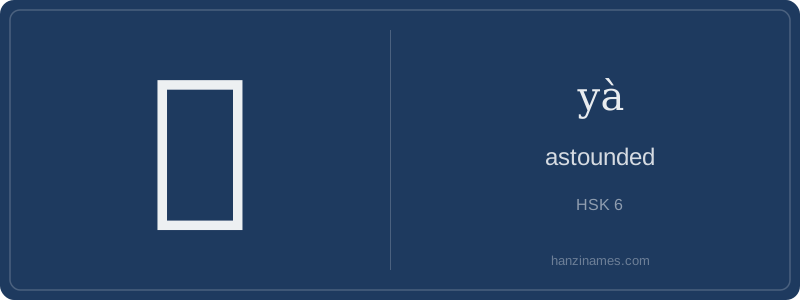
In modern Chinese, 讶 is almost exclusively used in formal or literary contexts to mean 'to be astonished' or 'to feel surprised', typically in written language, news reports, essays, or historical dramas. It rarely appears in casual speech—native speakers prefer 啊 (ā), 天哪 (tiān nǎ), or 哇 (wā) for spontaneous reactions. A well-documented phrase is 不以为意,后乃大讶 (bù yǐ wéi yì, hòu nǎi dà yà)—‘at first thought nothing of it, then was greatly astonished’—cited in Ming dynasty essay collections and still taught in advanced HSK 6 reading materials.
The character has no verified pictographic origin: it does not appear in oracle bone or bronze inscriptions. Its earliest confirmed form is in regular script (kǎishū) from the Tang dynasty. In daily life, Chinese learners encounter it most often in exam passages or editorial commentary—e.g., a journalist writing ‘专家对此结果颇为讶然’ (Experts were quite astonished by these results), emphasizing measured, intellectual surprise rather than raw emotion.
As a detective tracing the evolution of 讶, I begin at its modern form: a left–right structure with the speech radical 讠 on the left and 牙 (yá, 'tooth') on the right. This is not a pictograph of astonishment—but a phono-semantic compound: 讠 signals the word relates to speech or mental reaction (like surprise expressed verbally), while 牙 provides sound approximation for yà (though phonetically distant today, it reflects Middle Chinese *ŋˠaʔ, where 牙 was *ŋˠa). No oracle bone or bronze script forms exist for 讶—it’s a relatively late addition to the lexicon, first reliably attested in Tang dynasty texts.
The character’s absence in early scripts tells a story: astonishment as a lexicalized, written concept gained prominence only when refined emotional vocabulary became necessary in literary and bureaucratic contexts. During the Tang and Song dynasties, as classical prose evolved and anecdotal literature flourished (e.g., Records of the Grand Historian commentaries and Tang Dynasty Tales), verbs like 讶 were needed to convey nuanced psychological states—not just ‘fear’ or ‘joy’, but the sharp, speech-arresting jolt of the unexpected. Its six-stroke simplicity belies this sophisticated functional emergence.
Crucially, 讶 never meant ‘tooth’—nor does 牙 here symbolize biting shock. Rather, 牙 served as a phonetic scaffold in a time when sound systems shifted dramatically. Modern Mandarin yà diverged from 牙’s current yá due to tone split and consonant weakening, yet the graphic pairing endured because it worked: readers recognized both the semantic domain (speech-related reaction) and the approximate pronunciation. This is linguistic archaeology in action—not mythmaking, but evidence-based reconstruction of how Chinese writing pragmatically adapted to express inner life.
Example Sentences
Common Compounds
Similar Characters — Don't Mix These Up
Your First Step into Chinese Culture: Get a Chinese Name
Every journey into Chinese begins with a name. Use our free Chinese name generator to create a meaningful, personalized Chinese name that fits you perfectly.
Get My Chinese Name →