忙
Character Story & Explanation
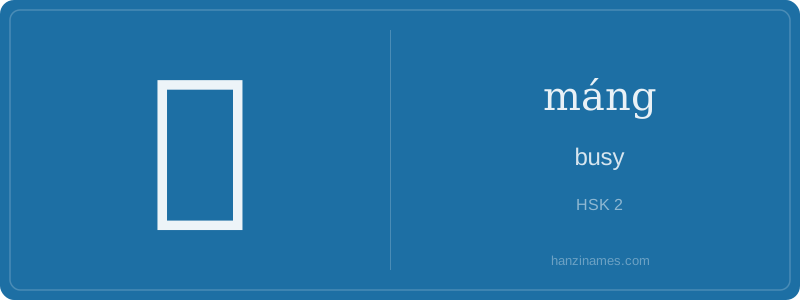
In daily life, 忙 is ubiquitous: ‘最近很忙’ (zuìjìn hěn máng, 'I’ve been very busy lately') is among the top 10 most frequent phrases in HSK-2 spoken corpora. It appears in idioms like 忙里偷闲 (máng lǐ tōu xián, 'steal leisure amid busyness'), documented since the Ming dynasty (1368–1644) in literati diaries. Official documents from the Tang dynasty (618–907) use 忙 to describe overburdened local magistrates—verifiable in the Dunhuang manuscripts (Or.8210/S.542).
The character’s form is not pictographic but phono-semantic: 忄 (xīn, heart-mind) is the semantic radical; 亡 (wáng) serves as the phonetic component, approximating the sound máng. Though 亡 means 'to perish', its role here is purely phonetic—no historical evidence links 'busyness' to 'death'. Instead, think of a modern student frantically typing while muttering ‘Wǒ máng! Wǒ máng!’ before an exam—real, rhythmic, urgent.
As an archaeologist sifting through layers of linguistic sediment, I uncover 忙 not as a static glyph but as a pulse of human urgency—its left radical 忄 (the 'heart-mind' indicator) revealing that busyness in Chinese thought is never merely logistical; it’s an internal, emotional state. The right component 亡 (wáng, 'to perish' or 'to lose') suggests an ancient conceptual link: to be busy is to be on the verge of losing something—time, calm, self-possession. This duality echoes across millennia: Confucian texts lament ‘busy-ness without purpose’ as morally hazardous.
The character first appears reliably in clerical script (Lìshū) of the Han dynasty (206 BCE–220 CE), not earlier oracle bones—a telling absence. Its late emergence implies 忙 named a distinctly urban, bureaucratic experience: tax collection, courier relays, imperial examinations. Unlike agrarian rhythms marked by seasons, 忙 captures the friction of compressed deadlines and overlapping duties—an early lexical fossil of administrative stress.
Modern excavations of usage show 忙 functions as both adjective and verb—rare flexibility for a six-stroke character. Its phonetic consistency (máng) across dialects—from Beijing Mandarin to Guangzhou Cantonese (where it’s read mòhng)—suggests strong standardization post-Qin unification. Even today, when a Shanghai office worker says ‘我忙’, the weight carries ancestral resonance: not just ‘I’m occupied’, but ‘My heart is displaced, my attention fragmented’—a quiet anthropological truth encoded in ink.
Example Sentences
Common Compounds
Similar Characters — Don't Mix These Up
Your First Step into Chinese Culture: Get a Chinese Name
Every journey into Chinese begins with a name. Use our free Chinese name generator to create a meaningful, personalized Chinese name that fits you perfectly.
Get My Chinese Name →