谎
Character Story & Explanation
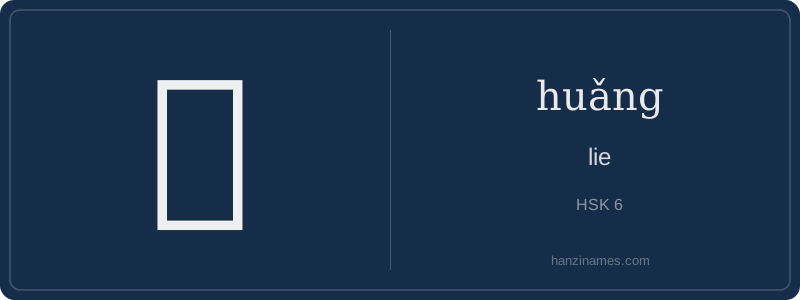
In contemporary China, ‘谎’ appears daily in public service announcements, school ethics curricula, and WeMedia content moderation guidelines. The phrase ‘不撒谎’ (bù sā huǎng, 'don’t tell lies') is a cornerstone of primary school moral education, mandated by the Ministry of Education’s 2022 ‘Moral and Civic Literacy Standards’. It also features in legal terminology: Article 293 of China’s Criminal Law criminalizes ‘fabricating facts to damage another’s reputation’, where ‘fabricating facts’ is routinely rendered as ‘编造谎言’ (biān zào huǎng yán).
The character combines the speech radical 讠 with 荒 (huāng, ‘desolate, barren’), first documented in the Shuōwén Jiězì (121 CE) as a phonosemantic compound — 荒 provides pronunciation (historically close to huǎng) and evokes semantic emptiness. No oracle-bone or bronze script forms survive; its earliest attested use is in Han dynasty texts describing deceitful speech in bureaucratic contexts.
‘谎’ (huǎng) is a key character for expressing falsehood in Chinese — not just casual exaggeration, but intentional deception. It appears in formal warnings, legal documents, and everyday moral instruction. Its radical 讠 (speech) signals that the lie originates in spoken or written language, not action or thought alone. This linguistic framing reflects Confucian emphasis on truthful speech as foundational to social trust.
The character’s 11-stroke structure balances simplicity and gravity: the left side (讠) anchors it in communication, while the right side (荒) — originally meaning ‘wasteland’ or ‘barren’ — metaphorically suggests emptiness, lack of substance, or moral desolation. In classical usage, ‘huǎng’ often appeared alongside words like ‘言’ (speech) or ‘语’ (language), reinforcing its semantic domain.
At HSK Level 6, ‘谎’ marks advanced lexical precision: learners must distinguish it from synonyms like ‘假’ (false, general) or ‘伪’ (counterfeit, artificial). It carries ethical weight — calling someone a ‘谎话精’ (habitual liar) is a serious social judgment. Its usage peaks in contexts demanding integrity: journalism ethics, courtroom testimony, and education policy — all areas where China’s regulatory frameworks explicitly prohibit ‘散布谎言’ (spreading lies).
Example Sentences
Common Compounds
Similar Characters — Don't Mix These Up
Your First Step into Chinese Culture: Get a Chinese Name
Every journey into Chinese begins with a name. Use our free Chinese name generator to create a meaningful, personalized Chinese name that fits you perfectly.
Get My Chinese Name →