谜
Character Story & Explanation
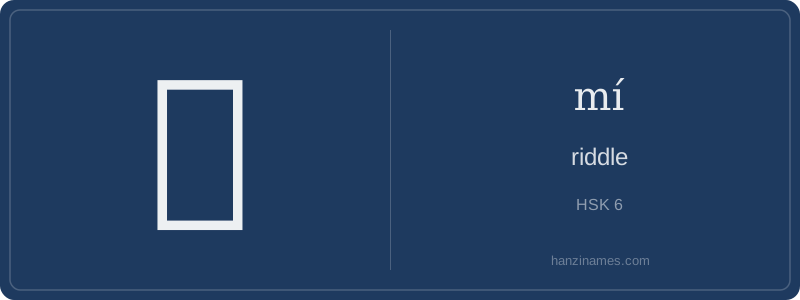
谜 is widely used in modern Chinese daily life—especially during the Lantern Festival, when public riddle-guessing events attract millions nationwide. The State Council officially listed ‘Lantern Festival Riddle Guessing’ as part of China’s National Intangible Cultural Heritage in 2008. Common phrases include 猜谜 (cāi mí, 'to guess riddles') and 谜语 (míyǔ, 'riddle'), both HSK 6 vocabulary items. Idioms like 谜团 (mítuán, 'tangle of mysteries') appear in news headlines describing unsolved cases.
谜 is a phono-semantic compound: left radical 讠 (speech/words) indicates its semantic field (language-based puzzles), while the right component 迷 (mí, 'to be confused; lost') provides both sound and meaning. First attested in bronze inscriptions of the Warring States period (475–221 BCE) as 迷, the character 谜 emerged later in Han Dynasty texts as a specialized variant emphasizing verbal puzzle-making—not an ancient pictograph, but a deliberate linguistic innovation for a cultural practice.
The Chinese character 谜 (mí) means 'riddle'—a deliberately obscure question or statement requiring clever interpretation. Unlike English 'riddle', which often implies playful wordplay or rhyme, 谜 carries broader connotations of mystery, ambiguity, and intellectual challenge. In Chinese culture, riddles are deeply tied to festivals like Lantern Festival (Yuánxiāo Jié), where solving riddles written on lanterns is a centuries-old tradition rooted in Song Dynasty (960–1279) customs.
While Western riddles (e.g., 'What has keys but can’t open locks?') emphasize lateral thinking and puns, Chinese riddles frequently rely on character analysis—deconstructing radicals, homophones, or historical allusions. For example, a classic 谜 might hint at a character by describing its components: 'Left is speech, right is hidden—what character am I?' (Answer: 谜 itself). This linguistic self-reference reflects the logographic nature of Chinese writing.
Culturally, 谜 also extends metaphorically beyond puzzles into realms of unsolved phenomena ('cosmic谜', 'historical谜')—similar to how English uses 'enigma' or 'mystery'. Yet unlike 'enigma', which leans toward solemnity, 谜 retains warmth and accessibility, appearing in children’s books, TV game shows (e.g., CCTV’s Riddle Night), and even tech contexts ('password谜' for CAPTCHA-like challenges). Its radical 讠 (speech) signals that riddles are fundamentally *spoken* or *communicated* puzzles—not just abstract logic problems.
Example Sentences
Common Compounds
Similar Characters — Don't Mix These Up
Your First Step into Chinese Culture: Get a Chinese Name
Every journey into Chinese begins with a name. Use our free Chinese name generator to create a meaningful, personalized Chinese name that fits you perfectly.
Get My Chinese Name →