谴
Character Story & Explanation
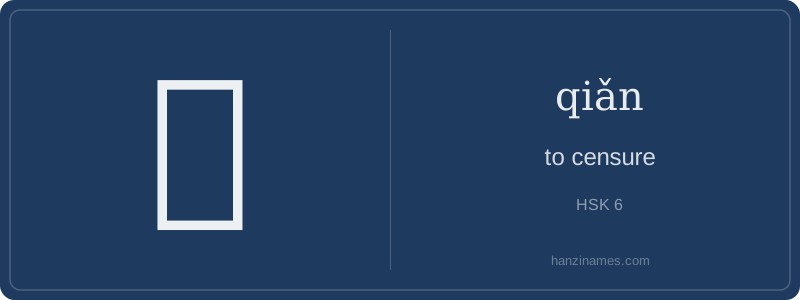
In modern Chinese, 谴 appears most frequently in official discourse: CCP disciplinary documents use 严重警告、撤销职务、开除党籍、予以谴责任何失职行为 — meaning 'severe warning, removal from post, expulsion from the Party, and formal censure'. It also anchors classical idioms like 天谴 (tiān qiǎn, 'heavenly retribution'), cited in state media when framing natural disasters or corruption scandals as moral consequences. Historically, imperial edicts employed 谴 to revoke honors or demote ministers — e.g., the Kangxi Emperor’s 1699 edict censuring a corrupt grain commissioner.
The character’s written form has no pictographic origin; it’s a phono-semantic compound. 讠 (speech) + 遣 (phonetic and semantic anchor meaning 'to dispatch') — confirmed by Shuōwén Jiězì (121 CE), China’s earliest dictionary, which defines 谴 as 'to blame formally, using dispatched words'. No oracle bone or bronze forms survive, so its earliest attested form is seal script.
Our detective begins at the crime scene: the character 谴, first documented in seal script (c. 3rd century BCE) as a compound of 讠 (speech radical) and 遣 (qiǎn, 'to dispatch'). The radical 讠 signals this is a verbal act — not physical punishment, but a formal, spoken condemnation. Early inscriptions show it used in bureaucratic contexts, where officials ‘dispatched’ reprimands to subordinates, merging authority with linguistic force.
Zooming in on the phonetic component 遣, we find it’s not just a sound cue — it carries semantic weight. 遣 itself means 'to send off', often with finality or consequence (e.g., exiling an official). So 谴 isn’t casual criticism; it’s a deliberate, institutionalized act — like issuing a formal censure that removes moral standing. This duality (speech + dispatch) makes it uniquely potent among Chinese rebuke characters.
The character’s evolution reveals tightening formality: from Warring States bronze inscriptions (irregular, multi-stroke variants) to standardized clerical script under Qin unification, then to regular script by the Han. Its 15-stroke structure stabilized early — no simplification occurred in the 1956/1964 reforms, confirming its entrenched status in formal registers. Today, it appears almost exclusively in written, high-register contexts: legal documents, party discipline notices, historical texts — never in casual WeChat messages.
Example Sentences
Common Compounds
Similar Characters — Don't Mix These Up
Your First Step into Chinese Culture: Get a Chinese Name
Every journey into Chinese begins with a name. Use our free Chinese name generator to create a meaningful, personalized Chinese name that fits you perfectly.
Get My Chinese Name →