誉
Character Story & Explanation
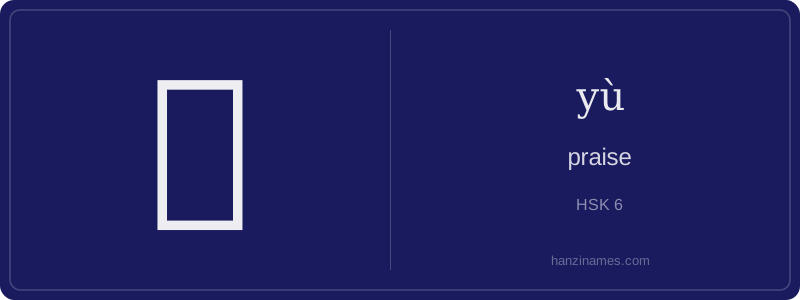
譽 is widely used in modern Chinese in formal, institutional, and media contexts: government commendations (如‘全国劳动模范’荣誉称号), academic awards (‘终身荣誉教授’), and legal phrases like 名誉权 (‘right to reputation’) — a protected civil right under China’s Civil Code. It appears in idioms like 众口铄金,积毁销骨 (collective slander can destroy reputation), underscoring its cultural weight. The term 荣誉证书 (‘certificate of honor’) is issued by schools, the military, and state agencies nationwide.
The character evolved from seal script; its modern form combines 言 (speech) and 与 (a variant of 予, ‘to bestow’). While oracle-bone or bronze inscriptions of 誉 are rare, the earliest confirmed usage appears in Warring States bamboo texts and Han dynasty texts like the *Huainanzi*, where it consistently denotes conferred prestige — never self-praise. Its structure reflects a core Confucian idea: reputation is granted by others through virtuous conduct and trustworthy speech.
Hello students! The character 誉 (yù) means 'to praise' or 'reputation' — it’s about honor earned through good deeds or words. It belongs to the ‘speech’ radical (言), which tells us it’s connected to language, communication, and what people say about someone. Though it looks complex with 13 strokes, remember: the left side is always 言 (speech), and the right side 与 (yǔ) originally meant 'to give' — so together, they suggest 'giving praise' or 'bestowing honor through words'.
This character appears in formal and literary contexts more than casual speech — you’ll see it in news headlines praising heroes, award certificates, or classical poetry. It’s an HSK Level 6 word, meaning it’s advanced but essential for understanding Chinese values around integrity, merit, and social recognition. Don’t confuse it with simpler praise words like 夸 (kuā) — 誉 carries weight, dignity, and lasting respect.
Writing it correctly matters: start with the 言 radical on the left (7 strokes), then the right side 与 (6 strokes). Practice stroke order slowly — especially the final dot in 言 and the balanced hook in 与. Because it’s often used in compound words (like 名誉 or 荣誉), mastering 誉 helps unlock dozens of high-level terms. Think of it as the 'gold standard' character for earned respect — not flattery, but sincere, public acknowledgment.
Example Sentences
Common Compounds
Similar Characters — Don't Mix These Up
Your First Step into Chinese Culture: Get a Chinese Name
Every journey into Chinese begins with a name. Use our free Chinese name generator to create a meaningful, personalized Chinese name that fits you perfectly.
Get My Chinese Name →